click for home page
travel & tourism information
business in Dominica
latest news from the Nature Island
help & contact info
click for home page

Heritage of Dominica

Caribbean Search Engine

a virtual Dominica:

Dominica Heritage

Related Links


Timeline

Caribs

Creole Language
Cricket
Carnival

Maps

Resources
Sounds of Dominica

Books


Advanced Search

We are pleased to be able to bring you excerpts from Dr. Lennox Honychurch's upcoming book about the heritage of Dominica. We will add new entries to the "A to Z of Dominica Heritage" as they become available. Watch this page for more information about the book!

A to Z of Dominica Heritage by Lennox Honychurch
reprinted with permission

Origin of Words: (A) African, (C) Carib, (E) English, (F) French

A | B | C | D | E | F | G | H | I | J | K | L | M |
N | O | P | Q | R | S | T | U | V | W | Y | Z

T

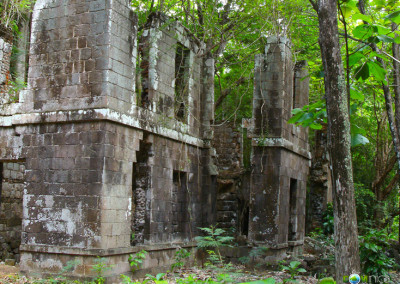
Tabery: (C) A former sugar and lime estate on the east coast near to La Plaine owned from the early 19th century by the Bertrand family and in the 20th century by the Winston and Potter families. It covered an area of 1,200 acres that extended up the Tabery River valley and along the seashore at Bout Sable beach. It gets its name from the Carib word for a house, Taboui. In the years just before emancipation Tabery was worked by 160 slaves and produced 87,000 lbs of sugar and 3,000 gallons of rum. The estate gradually went into decline and the ruins of the old sugar factory lie in bush near to the present main road.

Tablette: (F) A local sweet usually made of grated coconut boiled in sugar that hardens when cooled. Some boiled in brown sugar are caramel in colour while others boiled in white sugar are often coloured pink or green with vegetable dye. From the French, tablette, for 'cake, slab'.

Tache: (F) A large, round, copper or iron pot used from the 18th century to boil sugar-cane juice during the heating process that crystallized it into sugar. A series of taches stood in a row over a furnace and the thickening boiling juice was ladled from one tache to the other. Later, when the sugar industry declined, these were also used to boil lime juice, to concentrate it, and as a 'platin' for making cassava flour (farine). A Tache is also called 'cappa' in Dominica even if made of iron. From old French: 'plate of iron'.

Taffia: (F) An old French name for fermented cane juice used in the making of rum. The colour is a slightly cloudy brown. In the hills behind Capuchin flows the Taffia River, which was given this name by the French because the water, although quite clean, is always the colour of taffia. This is because it flows through volcanic clay that is part of the crater of the Morne Aux Diable volcano in an area called Soufriere. It appears on the earliest detailed map of the island by Thomas Jefferys, 1768, as "Taffia or Rum River". The Taffia River is the source of water for the village of Capuchin and it ends in a waterfall that cascades over a cliff directly into the sea. The track leading from Capuchin to Pennville crosses the river near Seaman Estate.

Tamarind: (E) These trees come from India and were introduced to Dominica during the 18th century. The trees have a dense dark green rounded crown and are long lived. Brown uneven pods, about three inches long, are usually seen hanging from the tree. The pulp that surrounds the seeds has a tart but good flavour. This is eaten raw or is made into juice. A sugared sweet of rolled pulp called "Tamarind Balls" is also popular. The pulp used to be exported in large quantities in the 19th century as an ingredient for sauces and preserves. In the late 18th century an avenue of Tamarind trees was planted all along the seafront of Goodwill Estate, from the Roseau River mouth to Fond Cole to protect the shoreline. About nine of them still survive and they are over 200 years old.

Tan, Bois Tan: (F) (Picramnia antidesmoides) This is a small shrubby tree. The leaves, when moistened and rubbed on an article to be coloured, yields a mauve dye. This dye is used by Carib artisans to colour the roots of the lianas called mibi (Anthurium palmatum or Monstera pertusa) used in making a type of round spiral Carib basket. Not to be confused with another tree also called Bios Tan and Moricypre (Byresonima spicata).

Tannia: (C) (Xanthosoma spp.) A starchy root tuber native to tropical America cultivated in Dominica since pre-Columbian times and which was probably brought to Dominica from the mainland by the early indigenous farmers. The word, tannia, that we use today, comes from the Carib name for it: taia. The French called it Chou Caraibe. It is one of the staple starchy foods of the island. The Caribs also cooked the heart of the tannia leaves as is done in the case of Dasheen. Some botanists mention a red-ribbed leaf variety, "chou poivre", whose juice the Caribs rubbed on themselves as a charm when going to war. Also called by some "chou fwedi" it is made into a tea used against chills.

Tarreau: (C) A community and cliff along the west coast. The name comes from: tuerou, the Carib word for the White-Tailed Tropic Bird (Phaethon lepturus), a seabird which nests in holes high up on the face of this cliff. The birds nest mainly between December and June, but are most active there in April and May when feeding their young. This bird also gave its name to a small fishing and farming community that grew up in the nearby valley during colonial times. Before Rodney's Rock was given its name in the 1780s, that headland was known as Pointe Tarreau. From the early 1900s a road was constructed along the beach at the base of the Tarreau Cliff and since that time successive governments have wasted millions of pounds and dollars fighting with the sea, rather than going the old way up and along the top of the cliff. However millions have just recently been wasted doing this as well for the aborted Electricity Power Plant.

Taylor, Douglas Macrae: (1901-1980) Linguist and anthropologist considered to be the most respected and prolific academic to be associated with Dominica. Born in Yorkshire, U.K., he was a graduate of St. Peter's College, University of Cambridge, where he studied modern languages. He became the world authority on the Island-Carib culture and a distinguished pioneer of Caribbean linguistics. His major works were "The Caribs of Dominica" (1938), "Ethnobotany of the Island Caribs" with W.H. Hodge (1957) and "Languages of the West Indies"(1977), just three of some 70 publications on Dominica alone, that included monographs and articles. Douglas Taylor first came to Dominica in 1930, residing permanently from 1938. Shortly after his arrival here he was accused of fomenting trouble in the Carib Reserve by the British Administrator, E.C. Eliot, and of encouraging the "Carib War" of September 1930, charges that Taylor strongly denied. His first marriage, to an American, ended in divorce and he then married Martina Benjamin, a Carib woman of Bataca, with whom he had several children. He spent most of his time researching and writing at his home at Magua, Bellevue Chopin, between his occasional teaching assignments at the universities of Yale and Oxford. In 1979, a year before his death, he was awarded an honourary doctorate by the University of the West Indies, which he received at the Cave Hill Campus, Barbados. He left Dominica after the destruction of Hurricane David and died in England in 1980.

Tea: (E) A British visitor to Dominica may be perplexed by our use of the word "tea". It does not merely refer to an infusion made of dried leaves imported from the Asia. That in Dominica is "green tea". Here, there are many other types of tea: "Cocoa Tea", made of roasted, pounded and grated cocoa beans, and any number of particular "bush teas". The latter is any infusion of herbs, including in certain cases their roots and/or flowers known to cure particular ailments or give relief. There are "hot teas" and "cooling teas". "Tea" also often refers to the first meal of the day, rather than the word "breakfast". This comes from the days of the plantation when "tea" was taken at sunrise before going to work and another "tea" was taken in the middle of the morning.

Temple: (E) An estate situated between Eden and Woodford Hill that was named in the 1770s after its first English owner William Temple. It was originally 196 acres in size, but by the mid 19th century was absorbed into Woodford Hill, then owned by Charles Leatham. In the 20th century Temple was part of a group of northern estates owned by Estates Investment Trust of Dominica and then by Captain Stebbings, whose widow sold it to Frobel Laville who some years later gave it to his eldest daughter at her wedding. In the 1970s the government of Dominica under Premier Patrick John compulsorily acquired the estate along with part of Woodford Hill as part of a scheme planned in conjunction with Attorney General Leo Austin and self-confessed Barbadian gun runner Sydney Burnette Alleyne to use as part of a proposed jet airport and offshore services centre. The plan never materialized, but government still owns the land, part of which has been donated for the establishment of a Seventh Day Adventist School.

Tete Chien: (F) (Boa constrictor nebulous) A robust brown snake with darker blotches on its skin forming a sinuous pattern along the entire body. It grows up to 3 meters long. Its French Creole name comes from the dog-like shape of its head. It is widespread from the dry coastal zone and cultivated areas through to the rain forest. Frequently encountered on country roads during the night or on land recently cleared for cultivation where it warms itself in the sun. It is particularly fond of stony areas where it can warm itself on rocks and secure itself beneath ledges. When mating, Tete Chiens gather in a "cavalage", or snake pit, writhing over each other, often a dozen at a time. The snake features prominently in Carib legends as in the case of the "L'escalier Tete Chien" at Sinekou and the "Pagua Rock" near Antrisle. It is generally harmless but is widely feared and is often killed by humans. It feeds on rodents and forest wildlife and domestic chickens.

Tete Morne: (F) A community in the heights of Grand Bay, meaning literally "at the head of the mountain". Situated on the ridge that separates the Grand Bay valley from the Soufriere valley, it is at the end of the motorable road. A walking trail continues from Tete Morne down into Soufriere, while another leads from Tete Morne south along the ridge to Palmiste Estate and then down into Bois Cotlette Estate, part of the old trails connecting settlements in the south of Dominica.

Thaly, Daniel: (1879-1950) Physician, poet, ornithologist and museum curator. Best known as a poet, he is the most neglected of Dominica's writers, because all of his works remain in French and since he studied and worked in Martinique, and we do not care, that French department has claimed him as their own. As in the rest of the French Antilles his work is studied and written about as a pioneer of Antillian self-awareness in literature. Born in Dominica on 2 December 1879, (his mother was a Bellot) he was educated at the Lycee St. Pierre in Martinique and studied medicine at Toulouse, France until 1905 when he returned to the Antilles. For years he was archivist at the Schoelcher Library in Fort-de-France, before returning to Dominica. Between 1899 and 1932 he published ten volumes of poetry and contributed to Parisian magazines and, later, in English, to the Canada-West Indies Magazine. Many of his poems have loving references to Dominica's beauty, particularly in "L'ile bleue" (the blue island). He was a keen bird watcher, providing an early record of many of the island's birds. He was curator of the Victoria Museum in Roseau and owned Hertford Estate, popularly called Jimmit on the west coast. He lived in Roseau, where the Wesley High School now stands, and where he died on 1 October 1950.

Thibaud: (F) This fishing and farming village is on the north coast near to Vieille Case. It appears on the earliest detailed map of the island by Thomas Jefferys, 1768. It is named after an early French settler Louis Thibaud (spelt in the early British texts as Teaubaud) who obtained ten acres from the Caribs in the early 18th century. The community is connected to two bays, one of which, Sandwich Bay, is named after the Fourth Earl of Sandwich (1718-1792). He was a member of the Board of Trade in England, later to become the Colonial Office, at the time that Dominica was ceded to Britain by the Treaty of Paris in 1763. The other bay is the beaching place for the fishing boats of Thibaud. The school playing field was the site of an Amerindian village. During the post-emancipation period the village grew as labourers from the estates of Moor Park and Blenheim settled there.

Titiri: (C) The Carib name we still use today for one type of Goby fish (Sicydium punctatum). Adult females lay eggs up the rivers in nests that are excavated in loose gravel by the males who also provide most of the parental care for the eggs. When the minute larvae hatch from the eggs they make their way down to the sea by a combination of river flow and cycles of downward sinking and upward swimming. Once out in the open sea, their post-larval growth quickens. Here they spend most of their time before returning to migrate up the rivers. Swarms of millions of Titiwi arrive at the river mouths, particularly along the west coast, to begin making their way up river to their mating and nesting places. Although Titiwi go from the sea into the rivers throughout the year, the highest yields are usually from September, peaking in November. The migrations occur regularly and reliably on the fourth day after the Moon's last quarter. At this stage they are only about 22 mm long and their colour darkens immediately on their arrival into fresh river water. Once in the river they move powerfully up streams over rocks, through rapids and up waterfalls. On reaching up river they mate and nest and the whole cycle starts all over again. Titiwi travel in such a mass that they are caught in baskets, fine nets and sacks at the mouths of the rivers. The most popular culinary preparation is to fry them in batter as "Titiwi Accras".

Ti Tou Gorge: (F) A narrow gorge in the heights of the Roseau River near Laudat that became a source of water for hydro-electricity from the early 1950s and a tourist attraction during the late 20th century. The name comes for the French Creole for "little hole" or opening. The gorge is formed by the action of water coming from the Freshwater Lake, which over thousands of years has cut its way through the thick layers of volcanic ash that compacted after the eruptions of Morne Macacque (Micotrin). This form of rock is called "welded tuff". As the water cut its way through this, it carved out pools and waterfalls over and around harder rocks lodged in the tuff. At the end of the gorge the water continued down river to cascade over the higher of the two Trafalgar Falls. When CDC was constructing the first hydro scheme in the 1950s, the mouth of the gorge was dammed so as to divert the water into canals and pipes. This raised the level of the water in the gorge so that it became a popular experience to swim up the gorge and it is now one of Dominica's tourist attractions.

Tobacco: (C) The tobacco plant (Nicotiana tabacum) is a native of the Caribbean and tropical America. The indigenous people of Dominica used the leaves in a number of ways. It was dried, shredded and inhaled as powder, blown on ailing infants by midwives, pressed and drunk as juice, chewed and used as magic charms and rolled and smoked as cigars. After Columbus' visits to the region, smoking, using pipes or cigars quickly became the fashion in Europe. The Caribs of Dominica developed a trade in tobacco with English and French mariners mainly at the Grand Anse anchorage, today's Portsmouth. They exchanged tobacco for iron axes, knives, mirrors, scissors and other trade goods. When French colonization began, tobacco, (Tabac Payie) production was the biggest trade item before coffee, sugar and rum took its place. In the 20th century, J.A.S. Garraway & Co. resurrected the tobacco industry, planting and processing its own crop at Hillsborough and in Roseau. Up to the 1960s, Hillsborough cigars were a high quality export and Hillsborough cigarettes took over the local market. Today, although the cigarettes are still produced, all the tobacco to make them is imported.

Tobino: (C) The Carib name for a small settlement on the north coast between Thibaud and Vieille Case. It overlooks an important archaeological site where indigenous people once had their village centuries before Columbus.

Toli: (C) A Carib word used in Dominican Creole, mainly during childhood, for the penis. It comes from the Carib, touli, ("it pierces") and had a double meaning among the Caribs for penis as well as a torch or flambeau. The touli as flambeau, was made out of Bois Chandelle (Erithalis fruticosa) a very hard wood, which exudes gum and ignites very easily. It was made of chips of the wood tied together to a length of about one meter. This touli "pierces the dark". Words that included touli, toula or toullou all relate to piercing, entering or enlarging. Toulloua: "to dig". Toulouti: "to thicken to grow large". Toulacoua: "to slip in". Katoulatou: "It is swollen". Toullougouta: "to spill, to ejaculate". Touli is one of the many examples of word play and the method of word and idea construction found throughout the Carib/Arawakan language.

Toluman: (C) Arrowroot, grown by the Caribs as a source of starch obtained from the rhizome roots. The word, toluman, is applied to several species of rhizome of both the Cannaceae, the Canna family and the Marataceae, the arrowroot family. The tubers are grated and squeezed to produce a starch used mainly for feeding babies. It was used in magic and a poultice made of it, mixed with wild bees wax, was said to cure the effects of poisoned arrows, hence the English name, arrowroot.

Tosh: (A) A small round piece of padding made of a coil of cloth or dried banana leaves, which is put on top of the head to act as a pad when carrying heavy loads on the head. Associated with the verb -tuta, -tota: "to carry, pick up, load" in Kikongo, Ci-Luba and other Bantu languages common to West Africa.

Toubak (too-bac): (C) Truancy, to stay away, especially from school: "To make touback". From the Carib word toua (ba), to run away, to secrete oneself.

Toucari: (F) Le Trou Quarre was the French name for the sandy cove north of Douglas Bay where there is a church and small village. Today it is written as Toucari. It was the site of the establishment of the first Roman Catholic chapel in the north of Dominica by French missionaries early in the 18th century. In an advisory to British sailors it was noted as "the first bay of shelter for ships sailing from the north or east of the island." It is a fishing village, but is increasingly visited by tourists who enjoy its picturesque setting and sandy beach with offshore reefs for snorkelling and scuba diving. A sunken wreck off the bay is said to be a World War I German vessel, which is popular with divers.

Toutwell: (F) Zenaida Dove (Zenaida aurita) This dove is a common resident and breeder in dry forest along the west coast and littoral woodland along the east and north coasts. It is well known for its mournful call, a gentle cooing. It is reddish-brown with a whitish abdomen and rounded tail with white tips. It usually feeds on seeds on the ground, but sometimes takes seeds and fruit from trees. The breeding season is generally from February to June. Because of its ground feeding habits, traps of African and Carib origin, made out of twigs, are often set in little clearings to catch Toutwells.

Trafalgar: (E) A village in the Roseau Valley that takes its name from an estate in the area that was named after the Battle of Trafalgar. This famous naval engagement was fought between the British and French fleets off the coast of Spain in 1805. It resulted in a major British victory and many places around the British Empire were named "Trafalgar" in its honour. In Dominica, an English family called Keay owned this estate and named it Trafalgar. As was the custom here, the area of the estate house and the land around it became known in Creole as Kai Keay (Keay's House). But by the 20th century, with the Keays long since departed, the pronunciation became "Kai Cheay". This is still the Creole name for the village. In 1827 Trafalgar was worked by 26 slaves who produced 4,225 lbs. of coffee. After the coffee blight of the 1840s it switched to growing sugar. In these years following emancipation, workers on the estate got access to land upon which to build their huts and establish gardens. It was one of the main settlements in the vicinity of Roseau that supplied the capital with vegetables. A track through the village led to the nearby twin waterfalls, which were also given the name, Trafalgar. In 1954 the Commonwealth Development Corporation (CDC) constructed a power plant at the base of the Trafalgar cliffs, utilizing water piped from the Laudat area to power electric turbines. A motorable road was built to service this project at the same time making the falls more accessible to visitors. In the 1960s, Trafalgar village began to expand and became a popular centre of entertainment with the opening of two discotheques, the first of their type in Dominica: Laye ka Fete and the Manicou. Land at Lilly Valley nearby was opened up for a government housing scheme and the estate of Shawford was later subdivided for private housing. In the late 20th century Trafalgar was virtually becoming a suburb of Roseau. A number of guesthouses sprang up led by Papillotte Wilderness Retreat and Nature Sanctuary. The Trafalgar Falls have become an important visitor site particularly for cruise ship passengers and tourism related services have joined agriculture as the main income earner of the village.

Treaty: During the colonial period the fate of Dominica was determined by a number of treaties agreed upon by the European powers, chiefly the British and the French, at different times in her history. Names were given to these treaties depending on where they were negotiated and signed. Islands such as Dominica were pawns in a game for international power and they were used like pieces of a chess game to further the fortunes of whichever nation had the upper hand around the negotiation table. This was based on military victories scored during wars between the two nations.

Treaty of Aix-La-Chapelle: This treaty declared that Dominica would remain neutral and be left to the Caribs forever and would not be contested over by the British and French. It was signed in the French city of Aix-La-Chapelle on 7 October 1748. It confirmed agreements of 1660 and 1668; the latter of which stated: "The island of Dominica shall remain in the state in which it now is and shall be inhabited by the savages to which it has been left, so that neither of the two nations may place her under possession." But even while the treaty was being signed there were already French settlers established on the island. In the years that followed, the British accused the French of breaking the terms of the treaty and used this as an excuse to attack and capture the island in 1761.

Treaty of Paris: This was the treaty that formally ceded Dominica to the British. It was signed in Paris on 10 February 1763 at the end of "The Seven Years War". During the war, which had been fought in Canada, India, the Mediterranean, and the West Indies, the British captured Dominica in a battle at Roseau on 6 June 1761. Article Nine of the treaty legitimised British ownership by European diplomatic convention and surveyors were sent out, land was sold, large numbers of slaves were imported and the classic 18th century plantation system was established.

Treaty of Versailles: This was the treaty that returned Dominica to the British after five years of French occupation (1778 -1783). It was signed in the Palace of Versailles 3 September 1783. It was part of the arrangements ending the American War of Independence, because France had joined the war on the side of the American colonists against the British. During the war, the French captured Dominica on 7 September 1778 and had hoped to hold onto it. But on 12 April 1782, Admiral Rodney defeated the French at the Battle of The Saintes. This victory gave the British the upper hand to demand Dominica back and the treaty confirmed this. The French tried to capture the island on two other occasions, in 1795 and 1805, but were unsuccessful and the island remained British until 1978.

Trembleur: (F) (Cinclocerthia ruficauda) A brown bird with dark reddish-olive upper parts about 23-26 cm in length with a long bill and yellow iris. It trembles and bobs, hopping from branch to branch, a characteristic from which it got its name. It lives mainly in the wet forests, although it occurs in secondary forests and drier woodlands. It nests in a cavity in a tree or builds a domed nest of grass with a side entrance. It breeds in March and April and lays two to three greenish-blue eggs.

Trois Pitons, Morne: (F) The second highest mountain on Dominica rising to 4,600 feet. It was named by the French for its three prominent peaks, which are best seen from the sea off the west coast. In fact, the summit is made up of several other lesser peaks all of which are the remains of individual volcanic cones that together comprise the entire massif. Recent volcanic assessment has suggested that Morne Micotrin (Macaque), to the south, may also be part of the Trois Pitons volcanic system. It is one of the seven live volcanic centers on Dominica. In 1918 there was a dispute between visiting British geographers over an altitude reading that Trois Pitons was in fact the island's highest mountain, but the traditional recorded height continued to be accepted. The massif is made up mainly of pyroclastic deposits and fragments of collapsed domes. It is an area of extremely high rainfall and is largely covered by elfin woodland and montane forest, with some rainforest at lower elevations. In 1975 the mountain formed the centrepiece of the Morne Trois Pitons National Park, which was declared a World Heritage Site by UNESCO in 1997.

Turtles: Family Cheloniidae. Sea turtles are members of the ocean-living reptile family that frequent the coastal waters and shores of Dominica to feed and lay their eggs. Their numbers have been declining as hunting and raiding of eggs has increased. The different species of sea turtle were among the best loved of the mythological creatures of the indigenous people. In legends it transported their ancestors across the ocean, in some stories back to South America, and it sheltered them under its massive shell. The species that still frequent Dominica are the Green Turtle (Chelonia mydas); Hawksbill Turtle (Eretmochelys imbricata); and Loggerhead Turtle (Caretta caretta). Of the leathery sea turtles, family Dermochelydae, the Leatherback Turtle (Dermochelys coriacea) is also an occasional visitor. The sites for laying eggs are being reduced to fewer and fewer beaches. Long ago the beaches were less frequented by humans but now the turtles arrive to almost certain death. The large sandy beaches of the east coast are most frequented: Bout Sable at La Plaine, Rosalie and Castle Bruce. In the north at Londonderry, Woodford Hill, L'Anse Torti, Hodges, Pointe Baptiste, Hampstead and Batibou among them, and Toucari to Pointe Ronde on the west coast. They arrive to lay at night and unfortunately the marks of their tracks in the sand lead poachers directly to their eggs.

Tyne: (E) The steam vessel RMS Tyne operated between the Leeward Islands and around the coast of Dominica from April 1891 to about 1906. It was chartered from the Royal Mail Steamship Company and was subsidized by the government of the Leeward Islands of which Dominica was at the time a member. Its regular inter-island schedule greatly facilitated the movement of labour and produce between the islands. At Dominica it took mail, goods and passengers around the island, anchoring off places such as Rosalie, Saint Sauveur, Marigot, Woodford Hill and Portsmouth to take on produce, mainly cocoa, lime juice and rum for onward shipment from Roseau. It did this coastal run until being replaced by the RMS Yare, which was reserved specifically for the Dominica coastal service..


back to top


U

Under Power: (E) A pool at a bend in the Roseau River just above Bath Estate Bridge that has been a popular bathing place for the youth of Roseau for generations. It gets its name from its location directly below the old Roseau electric power generating plant, hence "under power". The power plant, with generators running on diesel fuel, was built in 1929 and operated until the 1950s when it was replaced by the Trafalgar hydroelectric power station. The US engineer Andrew Green referred to the old power station sarcastically as the eighth wonder of the world. "For here in a land of many rivers, and right on the banks of one of the largest rivers on the island stands a power plant dependent on imported diesel fuel!" Just above the Under Power pool was a dam made of boulders, which channelled water into a canal to turn the mill at Bath Estate factory. The wall of the canal protected the cliff from erosion, but during the last forty years since the water mill went out of use, the canal and the wall have collapsed and the consequent undermining threatens the UWI Centre now located on the site of the power station. The size of the pool is much reduced but it still attracts regular bathers daily.

Union Club: (E) A social club established in Roseau during the 1920s by members of the commercial and professional "mulatre elite" as an alternative to the white dominated, mainly expatriate, Dominica Club established some twenty years earlier. The club house and surrounding garden and tennis courts were on the land now occupied by the Roseau Infirmary. The club provided a meeting place for the leading nationals of the day for topical discussion, to read papers, play billiards and tennis and to entertain visitors. It was famous for its annual Samedi Gras Dance on the Saturday before Masquerade, where traditional Dominica dress was de rigueur and where the "jip" and men's "national wear" as we know it today is said to have evolved. The club was associated with hosting the regional delegates of the famous "Dominica Conference" of 1932 held at the nearby St. Gerard's Hall. By the late 1960s, with many of the younger members of the families who supported the Union Club having migrated and the social situation changing, the Union Club was closed. In the 1970s it became a dancehall called the Green Grotto, the base for the Swinging Stars Orchestra. The building was destroyed by fire and later flattened by Hurricane David in 1979. In the early 1980s the present Infirmary was built on the site.

Union Estate: (E) An estate, originally 364 acres in size, located directly behind the village of Point Michele, now owned by the Pemberton family. Up to the 1860s it was a coffee and sugar estate owned by the Bremner family, the last being J.L. Bremner. In 1827 the estate was worked by 104 slaves who produced 36,500 lbs of coffee. Then it was bought over by T.P. Trail and Charles Beaurisseau, at which time it switched to producing only sugar. When Charles Beaurisseau died, a dispute over the land commenced between his widow and his son whereby the estate was the subject of a celebrated court case in the 1880s, Beaurisseau Vs Beaurisseau. By the early 20th century the estate was under Pemberton ownership. In spite of hurricane damage it still has one of the last existing wooden estate houses in Dominica, designed as a cube entirely surrounded by jalousie windows and built with all of the traditional facilities to withstand hurricanes, while at the same time allowing for excellent ventilation. These are design skills that today's builders have unfortunately abandoned.

United States of America: (E) Dominica has had a long association with the United States from even before the inception of that North American republic. The British colonization of Dominica in the 1760s - 1770s was fuelled with trade goods such as horses, flour, corn, salt fish, pitch pine and other wood products shipped down from the thirteen American colonies. When the War of Independence broke out and France joined on the side of the US in 1778, Dominica was one of the first colonies to be captured as part of the French offensive against Britain. The war affected Dominica very badly as food and material supplies from the US were cut off. American colonists who were loyal to the British were forced to leave the new nation after independence was recognized in 1783. Many of these "Loyalists" turned up in Dominica, expecting relief and land from the British Crown. Some grants were made and they introduced the growing of rice to Dominica. However the deteriorating state of the economy caused these settlers to move on elsewhere.
During the US Civil War (1861 -1865), Southern Confederate ships broke the Northern Yankee blockade of Southern ports by trading at Portsmouth in Dominica, while the British in Roseau, (who tended to support the Confederacy because of their important cotton trade), turned a blind eye to what was going on. At that time also, Portsmouth became a depot for American whaling vessels killing and processing whales in the South Atlantic and this continued up to the 1920s. Many Portsmouth men were taken on to sail with the whaling ships. In the 20th century the relationship was strengthened as Dominicans began to migrate to the US on Canadian and US ships that called at New York and Boston and made scheduled visits to Dominica. In 1941 secret aerial photos were taken of Portsmouth to assess the possibility of establishing a small US naval base there, but this was abandoned. After World War II, US cultural influence increased rapidly as American Christian sects, music, film, radio and much later, television, had an impact on society. American tourists, first in private yachts and later in cruise ships contributed to the fledgling tourism industry. During the Cold War (1945 -1989), and particularly after the Cuban Revolution (1959), Dominica and the other British islands were under close scrutiny by Washington. Since the 1960s the US Peace Corps has been active here.
In the 1970s particularly, the tensions of "communism vs. capitalism" were evident in local political posturing and jargon. In the 1980s the Grenada Revolution added increased tension to the local situation and this climaxed with Dominica's prominent support of the US invasion of Grenada in 1983. This heralded the period of PM Eugenia Charles' close relationship with the Reagan Administration and increased USAID programmes and military training and equipment for the local police force. In contrast to this the US attitude to international banana trading had a fatal impact on the local industry. As the 21st century progresses US cultural, social and political influence on Dominica seems set to intensify.

United Workers Party: (E) A political party founded in October 1988 by Edison James, Julius Timothy, Norris Prevost, Dennis Labassier and others who sought to provide an alternative to the ruling Dominica Freedom Party on one hand and the disorganized Dominica Labour Party on the other, in that the DLP was still recovering from its failures of the late 1970s and early 1980s. In the main, the leadership of the new UWP were the children of traditional working class DLP rank and file supporters who had benefited from the wider educational opportunities of the 1960s, attended university, and had entered into the commercial sector or the upper levels of local bureaucracy. In effect they represented a new economic class that had gone beyond the "labourer" roots of the old DLP but were being cold-shouldered by the traditionalist DFP. The UWP however sought to draw support from the new generation of "workers" in both camps. Their message struck a cord, for after only two years the Party, led by Edison James, won six seats in the 1990 General Election and formed the official Opposition in Parliament, picking up another seat at a by-election for the Salybia constituency in December 1993. By 1995, with the economy beginning to slip and the leadership of the DFP in transition, the UWP won a slim majority in the General Election of that year and formed the government from June 1995 to January 2000. In the General Election of 2000 the party narrowly lost to the DLP and formed the official Opposition once again, this time in a House of Assembly dominated by a DFP/DLP coalition.

Upper: (E) A term used in some of the English place names of Dominica to denote a place that is inland or at a higher elevation in relation to other parts of the same village or area. This is used in the case of Upper Pennville and Lower Pennville or more recently, and less officially, Upper Goodwill and Lower Goodwill. The most easterly lane that cuts across Roseau from north to south is likewise called Upper Lane.


V


Vai-ki-vai:
(F) Things that are done in a disorderly way; in an unplanned or haphazard manner; carelessly; shabbily. From the French: vaille que vaille, "at all costs, come what may".


Valley: (E) Dominica is a very mountainous island and thereby also an island of valleys. Several place names draw attention to this physical feature: Antrim Valley, Charlotte Valley, York Valley etc. In Creole the word "fond" is used in place of the English "valley" as in Grand Fond, Fond Zombie or Fond Miel. One valley however, which does not have a prefix in popular parlance is the Roseau Valley which is simply called "The Valley". It begins with Valley Road, leading eastward out of the capital and includes the villages of Laudat, Trafalgar, Wotton Waven and Morne Prosper. The use of the term was strengthened when new electoral constituencies were delineated in 1974 and the Roseau Valley constituency was created. The member elected here is popularly referred to as "the man from (or for) the Valley" most notably in the case of Henry George, DFP, 1980-1995.

Vanilla: (E) (Vanilla fragrans) A climbing orchid native to Mexico, but cultivated in the Caribbean, Java, Mauritius and other tropical regions for the seed pod, the vanilla bean, which yields vanilla extract. The green stem climbs by aerial rootlets and bears thick oblong leaves and clusters of large yellow-white flowers in February - March. The flowers have to be pollinated by hand because the insect that performs this naturally does not exist here. The pods are about 8 inches long with an aromatic pulp and small black seeds. They are picked green and then dried to prepare the extract. Dominica produced small quantities of vanilla from the 18th century, but the industry grew after the collapse of the lime boom in the 1920s, reaching its peak towards the end of World War II when shipments from Madagascar and the Far East to the US were disrupted. A Vanilla Growers Association was formed in the 1940s, but local setbacks, including a disastrous fire in which a whole season's crop was lost, and devious practices by some growers in substituting White Cedar (Powier) pods for vanilla beans, as well as international changes such as post-war shifts in trade and the invention of artificial vanilla essence, vanillin, killed the market. But by then farmers were shifting to their new hope: bananas!

Varé: (F) Fish known in English as Marlin and Swordfish (Makaira albida and Xyphias gladius). The sailfish (Istiophorus americanus) is also sometimes called a varé. These are large pelagic fish 20 to 100kg in weight. They are caught on a long line usually trolled behind a boat and are known for their speed, power and aggressiveness when being caught. The Creole name comes from "varé" or "spear" for the long pointed top jaw of the fish. This was often sawn off by fishermen and used as a file for woodwork or as a small grater. The pale flesh of these fish is firm and tasty.

Vauxhall: (E) A small estate up along the Melville Hall River in the north east of the island. It was named after an area in south London where a popular pleasure garden was located during the 18th century. A bridge in the area leading to farms on the south side of the Melville Hall River is called the Vauxhall Bridge.

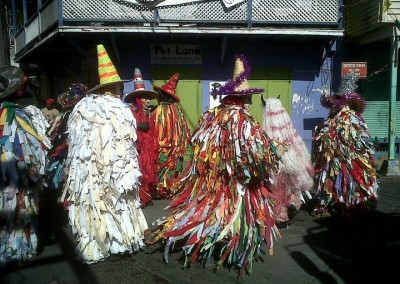
Vaval: (F) The spirit of Carnival, an effigy representing the spirit of Carnival. In the neighbouring French islands and in certain villages of Dominica revelers celebrate "Téwé Vaval" on the afternoon of Ash Wednesday, to symbolically bury or burn the spirit of Carnival. In the Carib Territory and at Dublanc, effigies of Vaval, made of old clothes, fiber stuffing and cloth or cardboard masks are paraded along the roadways and burned at sunset marking the end of revelry and the beginning of Lent. The practice dates from early Christian Europe and was brought to Dominica from the French islands where it is a very popular climax to the Carnival season.

Vep: (F) A free ride. The word comes from the Roman Catholic service of Vespers or Verpe at which a collection was not taken. The service was therefore "free". Anything obtained for free was then referred to as "a vep" in Creole.

Vert: (F) On such a forested island it is only natural that the French for "green" appears in some place names. However it usually refers to areas covered in patches of grass in the same way that the words savanne or paille are used. Examples are Morne Vert in the south between the Soufriere Valley and Grand Coulibri. Also Tapis Vert (green carpet) behind Salisbury and Grand Savanne.

Vernon, Admiral: A famous British admiral who visited Prince Rupert Bay with his fleet of ships in 1739 on his way to attack and capture the Spanish city of Porto Bello on the isthmus of Panama.

Vetiver: (F) (Vetiveria zizaniodes), A long-leafed grass, native to Asia and introduced to Dominica at the end of the 18th century. It came along with other plants including the breadfruit from the South Pacific, brought to the St. Vincent Botanic Gardens and then distributed to Dominica. The scented roots of the vetiver were dried and woven into small screens to perfume living quarters. The roots were also bundled to place in drawers and large Carib baskets for scenting linen and clothes. The Caribs bleached the leaves by boiling and sun dried them before splitting them in two for plaiting hats. The grass was also used as thatch. Vetiver mats were made by drying the leaves and then plaiting them into lengths. These were then coiled flat into decorative shapes and sewn together. In the 20th century a vetiver mat-making industry was developed by Belgian nuns through the establishment of the Convent Industrial School on Turkey Lane. A Vetiver mat was Dominica's wedding present to Princess Diana and Prince Charles in 1981. Vetiver was once widely used in agriculture to prevent soil erosion on hillsides. It was planted along contours as part of field maintenance and conservation, a practice that has foolishly been abandoned.

Vieille Case: (F) A village on the north coast situated on sloping land directly above ravines and sea cliffs created by volcanic outflows from the volcano of Morne Aux Diables. Due to its inaccessibility this area was still occupied by Caribs for over two hundred years after being sighted by Christopher Columbus. There are archaeological sites at Au Tou and Au Parc. The Carib name for the area is Itassi. The first recorded contact with the French was made between the Carib Chief Kalamiena of Itassi and Father Raymond Breton, a French Roman Catholic missionary of the Dominican Order then based in Guadeloupe. Breton lived among the Caribs of Itassi off and on from 1642 to 1648. Here in the chief's longhouse or karbay, he celebrated the first recorded Christian Mass with the inhabitants of Dominica in 1646. Through Chief Kalamiena and subsequent chiefs such as Le Baron, close French links were developed between the people of Itassi and the French in Basseterre, Guadeloupe. Two Carib men of Itassi were taken to France to train as priests; one died in France and the other returned but reverted to his former traditions. The contact with Guadeloupe encouraged settlers from poor white (petite blanc) families, who were being sidelined by the expansion of sugar industry in Guadeloupe, to come and settle among the Caribs. Most of the Caribs intermixed with these French smallholders and therefore many Vieille Case families have French and African as well as Carib ancestry.
They began to call the place Vieille Case apparently from the old Carib karbays that still stood there when the French arrived. Because of the steep jagged nature of the land, no large estates developed at Vieille Case even after the British took over Dominica in 1763. It remained a community of small holders, mainly peasant proprietors owning a few slaves to produce coffee. The tax records of 1827, for instance, show members of the Brumant families with 11, 14 and 15 slaves each and producing an average of 900 lbs of coffee a year. The four Royer holdings averaged 4 slaves each and Joseph Le Blanc had 7 slaves and Jean Baptiste Le Blanc had 9. However after the coffee blight of the 1840s, Vieille Case shifted to sugar. It was an isolated community well into the 1920s that had more contact with Mariegalante and Guadeloupe than it had with Roseau. The wider community is composed of many different zones such as Coton, Paille, Balthazar, En Bas and Au Tou among others. The church, run by the FMI fathers from 1872, was the focus of the community and the construction of the existing church began later in the 1870s. In the 1940s the Village Board system was introduced with much local opposition at first. Slowly by the mid-20th century a motorable road reached Vieille Case. Attention was drawn to the village from 1961, when one of its sons, Edward Oliver Le Blanc, became Chief Minister and later Premier of Dominica. Improved water systems, village roads, improved school buildings, a health clinic and electricity followed from the 1960s.

Visou: (F) Freshly crushed sugar cane juice. This was widely used for sweetening beverages and many house yards had a small press so as to crush sugar cane for juice whenever necessary. On the plantations, such as Canefield, that produced sugar up to 1900, "visou" applied to the juice before it entered the boilers or "taches" where it was heated into syrup " siwo", for the making of sugar. The domestic visou press consisted of a thick post or even a live tree trunk with a hole cut through it. A wooden lever was placed into this hole and a stick of sugar cane was put across a wedge cut into the wood below the lever. When the lever was lowered onto the cane, the juice ran out down a spout and into a calabash or other container. A few of these presses are still in use in certain villages. Today there has been a resurgence of demand for visou as a cooling drink but it is now crushed in motorized crushers and is sold ice cold.

Viv: (F) A type of fish (Malacanthus plumieri), family Malacanthidae. They are brownish gray with a hint of green and their dorsal and anal fins run continuously along the body. They live along the coastline.

Vivanno: (C) Types of sea fish, Silk Snapper (Lutjanus vivanus), Red Snapper (Lutjanus campechanus). When Fr. Raymond Breton was compiling his Carib Dictionary in 1665, the Kallinago/Carib people pronounced the word Oua-ioua-nao. He noted: "this [fish] is red and it is larger than the largest carp, known as Sarde, and there are several kinds".

Viyo: (F) River snail, periwinkle: An edible freshwater snail that lives on stones mainly in the larger rivers of the island. Viyo is easily picked off the rocks and boiled before laboriously taking the meat out of each shell using a sharp point. Hundreds of viyo are required for an adequate meal. Men particularly, will go to all of this effort because of its reputation as an aphrodisiac. The movement of viyo snails over rocks provides a forewarning of river flooding. As they sense the water rising they move higher up the rocks and around the boulders away from the force of the oncoming water that they know will follow. Viyo are very susceptible to the effects of pollution and have been affected in many places near farmlands by the runoff of agricultural chemicals.

Volant: (F) Flying fish, Atlantic Flying fish (Cypselurus melanurus) is a member of the family Exocoetidae. This family consists of 2 groups, the flying fishes and the halfbeaks, which share several characteristics: a nearly cylindrical body, with pectoral fins located high on the sides, abdominal pelvic fins, and posteriorly placed dorsal and anal fins. The flying fishes differ in having greatly enlarged pectoral fins and elongated pelvic fins, while most halfbeaks have a very long lower jaw. Flying fishes do not really fly, but glide above the surface of the water on their pectoral fins. There are 23 species in American and Caribbean waters. The fish are caught by hook and line or if the schools of flying fish around a boat are very large fish can be caught by scooping them up with a 'kali' basket or net.

Vont Balla: (F) A large cave along the route of the old walking trail from Pont Cassé to Castle Bruce that is said to have been one of the hiding places of the maroon chief, Balla, in the 1780s. It is situated about a mile to the east of Pont Cassé and was used as a sheltering place for walkers caught on the track during heavy rain or at night.

Vonti Zara: (F) A large cave near Belles close to the junction of the Pagayer and Layou rivers that was a hiding place for maroons in the 18th and early 19th centuries and was used by "Dreads" during the 1970s. It may also have been a retreat for indigenous people before Columbus. Today the mouth of the cave is bushed up and it is the home of thousands of bats.

Vwel: (F) A sail, from the French, voile. Sails are no longer generally used on Dominican fishing boats. They were abandoned with the advent of outboard motors from the 1960s. The square sails previously used for canoes were made out of eight cotton flour bags sewn together. The square sail was hoisted on a round wood mast at the bow of the canoe. It was kept open by a "veg", usually a narrow bamboo pole, placed diagonally across the sail from the base of the mast to the outer tip of the "vwel". The sails for the "bot" or "bot Santwa" were triangular and consisted of a jib and mainsail in the European tradition.


W

Wabio: (C) One of the words used to describe illicitly produced rum, also known as Mountain Dew or Zaid. Crushed sugar cane juice is fermented and distilled using basic paraphernalia of pipes, pots and glass 'demi-johns' to produce a raw rum that is sold and drunk without the license payments demanded by law.

Wai Wai: (C) An isolated estate in a valley on the south coast approached by walking from Fab and Retiro near to Fond St. Jean. It was a Carib settlement, which survived long after the French arrived and its Carib name has been maintained. The Caribs here mixed with the French and African arrivals and were ancestors of many of the present villagers of Bagatelle and Fond St. Jean.

Wallhouse: (E) An estate south of Roseau named after a place near Edinburgh in Scotland where John Gillion, the first British owner of the estate, came from. As elsewhere in Dominica, whatever name was given to the estate, the workers and people in the neighbourhood often called it after the owner. Therefore they referred to Wallhouse as 'Gillon', (pronounced in the Creole way 'jillon'). It had the layout of a classic self-contained 18th century sugar plantation. The Great House with its outside kitchen, servants' quarters and storerooms stood above and inland of the mill. This was powered by water channelled from the River Gillon in a canal across aqueduct arches to the waterwheel. A sluice gate also channelled water into the house where it fed a large stone bath and a constantly flowing water closet. Beyond the mill was the sugar curing house and distillery. (In the 1990s this wing was restored as a restaurant and discotheque). The manager's house and overseer's quarters were beyond that. (Opposite this Paramount Printery was built). The sugar cane fields were up the valley and on the wide, gently sloping ridge above the works. An identical layout can be seen at L'habitation Ceron in northern Martinique. At the height of its activity in the early 19th century, Wallhouse had its own jetty for shipping produce. In 1827 the estate was worked by 170 slaves, who produced 84,400 lbs of sugar, 1,526 gallons of rum and 3,086 gallons of molasses. In 1802 three of the first breadfruit plants to be brought to Dominica from Tahiti via St. Vincent, were grown here. Following the Gillon family, Wallhouse was owned by J.S. Laidlaw, then by J.C.Spooner in the 1870s, and later by Cox Fillan who shifted the crop from sugar to limes. By the 1920s the estate was 279 acres in extent and was owned by a group called The Wallhouse Syndicate. For a time the house was regularly rented to winter tourists from North America and used for local picnics and parties. The Syndicate was bought out by J.B. Charles who years later sold it to L. Rose& Company in the 1960s, who then sold to Leopold Emanuel in 1979. Charles kept the factory and Great House for himself, and from 1980 to 1995 it was the Prime Minister's residence, when his daughter, Dame Mary Eugenia Charles, served in that capacity. The rest of the estate on the ridge above was subdivided into streets and house lots as an extension of the suburbs of Roseau, similar to other formerly large productive estates around the capital such as Goodwill, Bath, St. Aroment, Canefield and Castle Comfort.

Waraka: (C) The Carib name for Atkinson, a community in the parish of St.David bordering with the Carib Territory. The Carib name went out of use after the original British owner of land in the area, William Atkinson, purchased it from the British Crown, which laid claim to Dominica after 1763. His location (Lease Lot No.1) appears on the first British survey of Dominica: the Byres Map of 1776.

Warblers: (E) A type of bird common to the forests of Dominica. They are scientifically grouped under Emberzines, the family Emberizidae, subfamily Wood Warblers, Parulinae. Some twenty-one species of wood warblers have been recorded on the island. The best known, are the Yellow Warbler, Dendroica petechia, called in Creole, titin. It is a common resident breeder, mainly at lower forest elevations. Also the Plumbeous Warbler Dendroica plumbea, called in Creole, papya. This is endemic to Guadeloupe and Dominica and is common in all forest zones. A number of warblers are migrants that make regular seasonal visits to Dominica, while others are vagrants only occasionally recorded.


Warner, Charles:
(E) When the British land sales began in Dominica after 1763, many planters from the 'old colonies' of the Leeward Islands came here to buy land as pioneers on this newly acquired island. Charles Warner of Antigua was one of these. He was a descendant of Sir Thomas Warner, the leader of the first English group to colonize St. Kitts in 1624 and was related to the Carib chief, Thomas 'Carib' Warner, who was killed at Massacre in 1674. Charles Warner purchased several properties around the island in the parishes of St. Andrew, St. David, St. Joseph and St. Paul where he had his main estate called Warner. In the parish of St. David his name also survives in the Charles Warner River, which is a tributary of the Pagua, flowing through part of the Carib Territory.

Warner: (E) A village in the parish of St. Paul situated at the edge of an extensive plateau that lies between the Belfast and Layou river valleys. For years it was an isolated settlement on the abandoned lands of the 18th century sugar estate belonging to the Antiguan landowner Charles Warner, after whom the village and plateau is named. Previously the area was an Amerindian settlement and several pre-Columbian artefact, particularly stone tools, have been found there. In the 1960s a motorable road was cut though from the Layou road near to Soulton and in the late 1990s another access was opened up from Belfast and Jimmit to provide a through road opening up the plateau. The area is known for the production of sweet potatoes, yams and vegetables. Charles Warner was an absentee landowner and after emancipation the estate was abandoned so that up to today, in certain parts, the landholding situation is confused.

Water: (E) The high backbone of mountains that cuts across Dominica from north to south stands in the path of moisture-laden clouds that are carried off the Atlantic Ocean by the North East Trade Winds. The height of the island forces these clouds to rise and as they do so rain falls and is most heavy on the east coast and in the interior, where measurements of over 300 inches per year have been recorded. This provides the island with a continuous water source from rivers and springs. Apart from being used for drinking and washing, water has been used to supply mechanical power for plantation factories and from 1905 and more extensively from 1954 for generating electricity. The first piped water system was provided for Roseau from Riviere Douce in 1874. The first legislation to control and operate water distribution was enacted under the Water Supply Ordinance of 1879. The Public Works Department was in charge of all government waterworks until the Central Water Authority was created by an Act of Parliament in 1967. The Dominica Water and Sewerage Company Ltd. (DOWASCO), incorporated by Act No.17 of 1989, replaced it in January 1990. Significant work on construction of reservoirs and intakes for villages around the island was undertaken in the 1950s and 1960s. For a time in the 1980s water was exported in bulk aboard tankers to neighbouring islands. A water bottling company was also established utilizing water from a spring at Snug Corner near Loubiere.

Waterfalls: (E) Dominica has dozens of waterfalls of various heights and sizes mainly in the southern half of the island where sheer cliffs have been cut out of the compacted volcanic ash known as 'welded tuff'. Streams cascade over these precipices and often cause the rocks to collapse around the waterfalls as the action of the water continuously carves out the cliffs. The highest fall is Middleham Falls in the Trois Pitons National Park on a tributary of the Boeri River. The most visited are the twin Trafalgar Falls in the Roseau Valley and the much smaller Emerald Pool Falls at the northern end of Trois Pitons National Park. Other popular waterfalls are Victoria Falls on the Riviere Blanche near Delices, Sari Sari Falls behind La Plaine, Spanny's Falls on the Pagayer River at Penrice, Milton Falls on the Dublanc River near Syndicate and Crayfish River or Isulukati Falls in the Carib Territory. Most spectacular perhaps are the isolated triple waterfalls, cascading one above the other, at Beaulivre in the mountains behind La Plaine. In the north there are the Blandy Falls on a tributary of the Indian River, and the Bwa Nef Falls between Vieille Case and Pennville. Some waterfalls cascade directly into the sea, such as the Taffia River Falls near Capuchin, the Ravine Ma Robert Falls near Riviere Cyrique and Belvedere Falls near Boetica. Together these falls contribute significantly to the island's beauty and in economic terms to the variety of Dominica's tourism product.


Watermill: (E) A type of mill used on Dominican estates for crushing sugar cane and limes and for pulping coffee, that was powered by the force of running water. The first watermills were constructed under the direction of the British from the 1760s and there were eventually some fifty-five of them in operation all over the island. The technology had been in use in Europe since Roman times and it was adapted to the plantations in the West Indies.
The fast flowing rivers of Dominica were excellent for this technology. Stone canals, some of them with arched aqueducts, such as those at Wallhouse, Castle Comfort, Canefield and Rosalie, conducted water onto large waterwheels. The largest of these wheels were 24 feet in diameter. They were divided into troughs and the wheel turned as each trough filled with water. In some cases the water poured from the top, called overshot wheels, while in others, water came in at a lower level, called undershot wheels. The wheel was connected to cogs that turned the rollers. The supply of water to the mill was controlled by sluice gates in the canal. But this did not stop the mill at once and there were many accidents when workers' arms were caught in the rollers while feeding it with limes or sugar cane. An axe was placed nearby to cut off limbs caught in this way, but, as in one case at Bath Estate, workers were sometimes crushed to death.
At Canefield in the early 1900s and at Rosalie in the 1950s watermills were adapted to produce electricity. Only one factory, Macoucheri, is still powered by water using a Pelton wheel, rather than the traditional large overshot wheel that was common here. The best examples of watermills still in place are: Hampstead, Rosalie, Curry's Rest, Belfast, Hillsborough, Blenheim, Bagatelle, Geneva and Soufriere.


Watt, Morne:
(E) A mountain in the southern central part of Dominica overlooking the Valley of Desolation. It was named in the 1870s after Mr. Edmund Watt, the Magistrate for the La Plaine District at the time. Along with Dr. H. A. A. Nicholls, he is credited with making the Boiling Lake known to the world. In early 1875, Mr. Watt decided that he was tired of going from Roseau to La Plaine along the Freshwater Lake Road, the Chemin Letang, and so he decided to cut across the island from Morne Prosper and approach La Plaine from the hills behind it. In attempting this he got lost in the forest for several days and emerged at Laudat weak and with his clothes in shreds. He did however report that over a precipice he had seen a boiling crater and numerous hot springs. Based on this, Dr. Nicholls and Watt organized a special expedition with porters and bush cutters and eventually made it to the Boiling Lake on the same path that is still used today. Nicholls gave his name to Morne Nicholl and Watt gave his name to Morne Watt. There is no record of an earlier name. Although it was once possible to climb to the summit, drastic erosion following Hurricane David in 1979 has made the ascent impossible. In the 1990s Morne Watt, along with the Valley of Desolation was classified as one of the seven 'live' volcanic centres on Dominica.

Wawa:
(A) A species of wild yam (Rajania sintenisii) found in the forests at lower and middle elevations and called by the Caribs bihi and kaiarali. But it is now known by its African name "wawa" from the Twi language for 'large tree' in that it is a tree-climbing yam with a widely spreading root system. It was the main food for the Maroons in their camps in the mountains and was mentioned in the reports of British governors as being one of the reasons for their survival. Although it was much used by the Caribs they never cultivated it because of the belief that if they did so it would cause their family to die out.

Wesley: (E) A village in the north east of Dominica situated between the old estates of Eden and Londonderry. Like many other villages along the east coast Wesley developed after Emancipation on hilly land along the boundary between the two estates as labourers sought to establish independent holdings for themselves away from the plantations where they had formerly lived and worked. In the mid 19th century, Charles Leatham, owner of Eden, sold several small lots in this area. His estates had been centers for early evangelization by Wesleyan missionaries and by as early as 1837 religious and night school gatherings were being held in a large estate building on Londonderry estate. Methodist influence grew further when free labourers were introduced into the estates of the northeast from Antigua and other Leeward islands to replant the sugar estates in cocoa and limes. By the 1860s the settlement was referred to as Wesleyville and was dominated by a woman shopkeeper called Ma Wesley. Eventually the place was simply called Wesley, while the district continued to be called by its old French parish name, La Soie (La Swa). At the end of the 19th century the Roman Catholic Church began to make a move to evangelize the area, but so strong was the Protestant influence that it had to buy land for the first church by using one of its faithful to purchase the land in his name and then to declare it for the church after the sale was completed. Tensions between the two faiths were high for a time. In the 1940s and 1950s large-scale land settlement schemes in the interior organized by the British government enabled villagers to buy Crown Lands and free themselves of dependency on the estates. This coincided with the beginning of the banana boom and Wesley benefited materially from this development. Economic growth enabled villagers to improve their housing and send children to secondary schools in Roseau. In 1979 the opening of St.Andrew's High School provided such education closer to home. National political changes also had an effect on the general changes in the community.

Whitchurch, Harry, Herbert, Vivian: (1869-1946) Estate manager and founder of H.H.V. Whitchurch and Company Limited. Born into a shop-keeping family in Southampton in England in 1869, Whitchurch came out to Dominica to manage various estates including Woodford Hill, where he is said to have laid out Dominica's first and so far, only, nine-hole golf course. In 1910 he went into business in Roseau gradually building up a general and commission merchant enterprise, insurance, automobile and shipping agency, dealership in dry goods, groceries and fuel. Whitchurch was made agent of Lloyds of London in 1926. He lived at Ross Cottage on Morne Bruce. One of his two daughters, Gwendolyn, married James Otto Aird, originally from British Guiana, who arrived to work in Dominica after serving in World War I. Aird became managing director on Whitchurch's death in 1946 and his descendants have managed the company ever since. The company operated from buildings on Old Street until their total destruction by fire in 1961. As a result, the company purchased the old L. Rose& Co. building on New Street (now Kennedy Avenue). Whitchurch & Co. sold this in 1984 and then repurchased and restored it in 2002. Meanwhile the Old Street property was extended and rebuilt, opening as a shopping centre in 1975, while new offices were completed in 1984. Along with J.A.S. Garraway (1828) and A.A. Baron & Co. (1896), L. A. Dupigny (1918), H.H.V. Whitchurch is among the oldest merchant companies still operating in Dominica.

Whites:
(E) A common name for people of European origin (see also Béké). The number of white people on Dominica has fluctuated remarkably over the years, rising and falling in relation to the economic activity. Whites were recorded living among the Caribs, adopting Carib ways, as early as the mid 1500s. The first group of white French colonists arrived from Martinique and Guadeloupe as itinerant woodcutters. From 1715 poor whites, the 'petite blancs' or 'béké pauvre', arrived to establish small farms on Carib lands. They were being edged out of the neighbouring French colonies by the expansion of big sugar plantations. Among these arrivals were families such as Anselm, Bardouille, Bellot, Barron, Blanchard, Corbett, Coipel, Darroux, Dechausse, Desabaye, Dubois, Dupuis, Durand, Foi, Fontaine, Giraud, Laurent, Labadie, Lafond, Laronde, Laroque, L'Audat, Le Blanc, Marie, Mourillon, Sorhaindo, Panthier, Peltier, Royer, Riviere, Rolle, Serrant, Titre and Vidal among others.
When the British captured the island and took it over in 1763 there was a surge of white British settlement as plantations were established. Laws were passed decreeing that for every 100 acres purchased, owners had to put on it one white man or two white women so as to build up the white population but this was never realized. Legislation from the 1760s protected white privilege in the courts, parliament, militia and other areas of public and private life. Eventually all forms of racial discrimination for "free people" were abolished in 1832. This did not necessarily change social attitudes or ethnic divisions. The dominance of "the Mulatto Ascendancy" in politics and commerce from 1838 confronted white power and during this period Dominica was described as "the only island in the West Indies where white rule was successfully challenged". The white population declined rapidly at this time reaching an all time low in 1891 when the census recorded only 41 whites, over half of them being priests and nuns. Numbers of whites rose during the 1890s with new British attempts at settlement and investment in limes, coffee and cocoa, but fell sharply again during World War I and in the 1920s after the collapse of the lime industry. The number of resident whites remained low until a slow rise from the 1980s but Dominica still maintains the lowest percentage of locally born whites per head of population in any Caribbean state after Haiti.

WIBS, Windward Islands Broadcasting Service: (E) From 1955 to the end of October 1971 Dominica's local radio service was operated by WIBS, a regional broadcasting network with headquarters in Grenada, inaugurated in 1955. Transmission took place locally on medium wave while the Eastern Caribbean was covered by short wave from a 5 KW transmitter. Dominica's transmitter was located at the Stock Farm. The first local studio was in a room in the old hospital on Bath Road and, when that building was destroyed by fire in 1965, it moved to a room behind the Public Library. The establishment of the station and the running costs for the first few years were provided by British Colonial Development and Welfare Funds (CDW). The Windward Islands of Dominica, Grenada, St. Vincent and St. Lucia shared the air time throughout the day with Dominica having a news time slot at 1.15 pm (a time that has been maintained up to today) and in the evening. It enabled much closer communication and news information exchange between the islands than today. The first WIBS announcer for Dominica was Mrs. Daphne Agar followed by Mrs. Mary Narodny and then Messrs. Francis Andre, Barnet Defoe and Jefferson 'Jeff' Charles. In the late 1960s Premier Eric Gairy of Grenada decided that he wanted his own national government radio station and WIBS fell apart with each island going its own way. Radio Dominica (now DBS) opened its new premises and went on the air, 1 November 1971 as WIBS came to an end.

Wiers:
(E) The name of the central section of the community of Marigot. It comes from the name of the first Englishman to purchase land in this district in the 1760s, William Wier.

Windblow: (E) A name that is most common in the northeast of the island. It usually refers to places along high ridges in farming areas that get the constant blast of the Trade Winds coming in from the east. There are areas called Windblow near Calibishie and at Bataca, with a Windy Hill at Marigot.


Windsor Park: (E) A recreation ground named after Windsor in England and situated on the eastern side of Roseau. It had been leveled out of a rubbish dump previously known as Cow Town. It was a popular venue for sports of all kinds, carnival activities, horse and donkey racing and State parades and played a central role in island life. In 1999 a national stadium was planned for the site, but after demolishing all of the existing stands and adjoining buildings, including a former school that had once been wards of the Roseau Hospital, the project stalled and the site has reverted to bush.

Windward:
(E) An old seafaring term from the days of sailing ships, used to describe the direction from which the wind comes. That part of the island facing into the path of the constant North East Trade Wind has been called the Windward Coast from early colonial times. In French and in Creole it was called "Au Vent" and well into the twentieth century newspaper reports and official documents would describe the east coast simply as "Windward" as in: "News has reached us from Windward that the iron bridge across the Rosalie River has been completely swept away by the recent floods".

Windward Islands: (E) The group of mountainous islands from Dominica to Grenada that forms the southern half of the Lesser Antilles. The Windward Islands were so described because they were thought to arch a bit further east out into the Atlantic Ocean facing the Trade Winds. North of Dominica the arc of islands curves more to the west and these have been designated as the Leeward Islands. The Windward Islands only refers to the English speaking islands as the French ones are excluded. Rather confusingly Dominica has been tossed from one group to the other at different times. From 1763 to 1770 the British governed it as one of the "Caribee Islands" made up of Tobago, Grenada, St.Vincent and Dominica (St. Lucia was French at the time) with its headquarters in St.Georges, Grenada. From 1770 to 1871 Dominica had its own separate colonial government, but then in 1871 it was declared a "Leeward Island" with its headquarters in St. John's, Antigua. In 1940 Dominica was placed back as a Windward Island with a Governor based in Grenada, until it got self governing Associated Statehood in 1967. However in such cases as the banana industry, cricket teams or radio, as in the Windward Islands Broadcasting Service (WIBS) and in tourism literature, Dominica has still been described as a Windward Island long after its political association was over. At the end of the 1980s/early 1990s there was a short-lived flurry of activity to create a political union and 'Constitutional Assemblies' were held with great fanfare in all of the Windward Islands. But this came to nothing.

Woodbridge Bay: (E) The main port of Dominica where deepwater facilities were constructed in the mid-1970s. It is named after William Woodbridge, the first British owner of Goodwill Estate in the 1760s. His estate bordered most of the bay from the Roseau River mouth to Ravine Cocque and so the first British mapmakers gave his name to the bay.

Woodford Hill: (E) An estate and a village on the north-east coast of Dominica extending from Eden River to L’Ance Noir. A significant Amerindian village existed at the mouth of the Woodford Hill River from at least 1,400 years ago. When the French arrived here in the early 1700s they called the place La Soie, after the Bois La Soie bush. The whole parish was called Quatre de La Soie. At the British occupation of Dominica from 1763, the area was put up for sale by the crown. Three hundred acres was bought by Napleton Smith. As in other parts of Dominica, the name of the owner was more commonly used than the name given to the estate. Hence the present Creole name for the village of Woodford Hill is Simit (the ‘cockoy’ or English Creole pronunciation of Smith).

For most of the 19th century it was owned by the ‘sugar king of Dominica’ Charles Leatham and his heirs and due to its gently sloping land was one of the largest sugar producing estates on the island. Five years before emancipation, Woodford Hill was worked by 112 slaves, producing 66,000 lbs of sugar, 2,550 gallons of rum and 400 gallons of molasses. The ruins of the sugar works can still be seen by the seashore. Here there was a harbour for coastal trading ships and a small fort on La Soie Point to defend the bay. In 1795 a French invasion force landed at the bay in an unsuccessful attempt to capture the island. As in most cases along the north and east coasts, the post-emancipation village developed on hilly land between two estates, in this case Woodford Hill and Hodges. At the end of the 19th century Woodford Hill amounted to 1,123 acres and was bought by Estates Investment Trust of Dominica who owned it up to the 1930s when it was bought by Capt. Stebbings, whose widow sold it to Frobel Laville in the 1940s and who in turn sold it to Messrs Foley and Band of Antilles Products in 1948. When the Van Geest banana company bought out Antilles Products in 1954 the estate was transferred to Geest.

In 1974, a large portion of the estate along the coast was compulsorily acquired by the DLP government of Patrick John for a supposed jet airport and other projects to be developed under an agreement with a self-confessed gunrunner, Sidney Burnette Alleyne. These were not forthcoming. In the late 1970s and 1980s Geest divided the rest of the estate into farm lots, sold mainly to villagers of the northeast. The village of Woodford Hill is on the western boundary of the old estate. It is made up of different sections including Small Farm, Mount Sylvie, Lareau and Big Cedar. For a long time Woodford Hill was perceived as a depressed village of former estate workers, but since the 1970s improved services including a new government school, health centre, a Credit Union and improved private housing has changed the community.

Wotton Waven: (E) A village and estate in the Roseau Valley that was named after a place in England. The estate was owned from the 18th century by the Laidlaw family who were prominent English landowners in Dominica from the beginning of British colonization in 1763. In 1827 the estate was 362 acres in extent and was worked by 32 slaves who produced 12,325 lbs of coffee. The coffee blight of the 1840s ruined the estate so a change was made to sugar. In the 1860s it was owned by J.S. Laidlaw, but at the end of the decade it was bought by H.C. Lipset. A decline of the sugar industry forced him to shift to growing provisions. After Emancipation and Apprenticeship, former estate labourers settled on its lands. Although this was the foundation of the present day village it resulted in difficult land ownership questions in the 20th century. From the 1870s ownership changed to J. M. Stedman and in the early 20th century it was bought by W. H. Chamberlain and was later sold to its present owners, members of the Rolle family. This was a period of economic depression when British landowners, whether resident or absentee, were giving up any hope of making any profit in Dominica and were selling out to local merchant families of the so called "mulatto elite" who had the money to buy. The estate includes an area of volcanic fumarole activity. These Wotton Waven sulphur springs have attracted visitors for centuries and are a possible future source of geothermal energy.


Y

Yachting: (E) The yachting industry is a part of the local tourism product that has received little attention from tourism administrators over the years. There is as yet no marina on Dominica and except for efforts made by the Anchorage Hotel to attract yachts to anchor offshore and use its facilities no major initiative has been aimed at this sector. Concern over damage to the coral reefs in Soufriere Bay encouraged the placement of buoys to moor yachts there. Large pleasure yachts from the New England seaboard of the US in the 1920s was the beginning of our tourism industry as wealthy families chartered yachts to the Caribbean in the winter. Before air services and cruise ships, yacht arrivals provided the main tourism business apart from visiting cargo/passenger steamships. Prince Rupert Bay at Portsmouth provided the best anchorage with Soufriere second. In 1953, Ann Davidson, the first yachtswoman to cross the Atlantic Ocean single handed made her landfall at Prince Rupert Bay.

Yam: (A) (Dioscorea spp.) A tuberous root of which there are many varieties that are cultivated and eaten in Dominica and throughout the Caribbean. The word comes from several West and Central African languages such as Fula and Twi in which words such as nnyam, nyiama, enama also mean 'meat', 'food' and 'eat'. Some of the yams cultivated here were brought from Africa in sailing ships during the time of the Slave Trade (Old World Yams) while other yams are indigenous and were used by the Caribs long before the arrival of Columbus (New World Yams). There are over 600 species of yam in the tropics, however only ten of these are of any importance as food and there are great variations in the size and shape. In Dominica the African Old World yams are: the greater yam (Dioscorea alata), the yellow Guinea yam (Dioscorea cayenensis), known here as yam jaune, the white Guinea yam (Dioscorea rotundata), yam blanc, and the lesser yam (Dioscorea esculenta). Among the New World yams are the Cush-Cush (from the Carib, kúsu) and the Wa-wa (Rajania cordata) a wild yam in the forest. The Creole names for the different varieties of yam vary from one part of Dominica to another and they include names such as: yam d'leau, yam batard, yam marron, yam a piquants noir, yam bonda, babaoulay, yam Antoine and lady's yam etc. Yam is generally peeled; cut into chunks and boiled, but is also roasted or pounded in a 'mash pilon' and made into 'ton-ton' or mashed and made into a pie.

Yanga: (C) Delicate palms of the deep forest. The two species are endemic to Dominica, Geonoma dominicana and Geonoma hodgeorum, named after the botanist W. H. Hodge who discovered it in the 1930s and 1940s. The former species is more common on forested slopes and wet shaded ravines, while the latter is found in the Elfin Woodland on the summits of Dominica's tallest peaks. The Caribs used Yanga leaves for thatching their houses.

Yanmpen: (A/F) The Creole for Breadfruit. 'Yanm' comes from several West and Central African languages such as Fula and Twi in which words such as nnyam, nyiama, enama also mean 'meat', 'food', 'eat' and 'yam'. It is combined with the French word 'pain', for bread, to be translated as 'yam bread'. In some parts of Dominica breadfruit is also called 'penpen'.

Yattahou: (C) The Carib name for two species of palm that are found throughout the forest at upper elevations. Euterpe dominicana, endemic to Dominica, is also known as Palmiste and its terminal bud at the centre of the leaf stalks (che palmiste) is eaten as salad, the leaves were used for thatching houses, while the prop roots (wacine palmiste) are used in basketry. Euterpe globosa is found on the highest peaks and its bud leaves are also edible.

Yare: (E) A small steamship that was leased from the Royal Mail Steam Packet Company of Britain by the government of Dominica in 1900 to carry produce, people and mail around the island in the days before motorable roads. It also made trips to neighbouring islands and could be hired for excursions. It stopped offshore at places such as Stowe at Grand Bay, Point Mulatre, Plaisance at La Plaine, Rosalie, Saint Sauveur, Marigot, Woodford Hill, Hampstead, Portsmouth and the larger west coast villages before returning to Roseau. It was named after the river Yare in England.

Yaws: (C) A tropical epidemic and contagious disease of the skin, also known as framboesia,