Related Links
Timeline
Caribs
Creole Language
Cricket
Carnival
Maps
Resources
Sounds of Dominica
Books
Advanced Search
|
We are pleased to be able to bring you excerpts from Dr. Lennox Honychurch's upcoming book about the heritage of Dominica. We will add new entries to the "A to Z of Dominica Heritage" as they become available. Watch this page for more information about the book!
A to Z of Dominica Heritage by Lennox Honychurch
reprinted with permission
Origin of Words: (A) African, (C) Carib, (E) English, (F) French
N
Napier: Elma (1892-1973), Lennox (1891-1940). A British couple who settled at Calibishie with their family in 1932 and became deeply involved in the life of Dominica. In 1937, Lennox Napier was elected representative for the Eastern District stretching from Pennville to Morne Jaune. Most notable was his fight for boat-landing and sea shore rights for the villagers of Woodford Hill and Wesley, establishing the right of Dominicans to have access to their beaches, and his representation to the Colonial Secretary in London on the needs of Dominica prior to the Moyne Commission visit of 1939. In 1940 his wife, Elma, succeeded him in the legislature, becoming the first woman in the Caribbean to be elected to parliament. Her main contribution was pioneering of village boards, self-help programmes and leading the campaign, along with Lionel Laville for the construction of a motorable Transinsular Road connecting the north to the south for the first time. She was the author of travel and autobiographical books and wrote two novels set in Dominica: "A Flying fish Whispered" and "Duet in Discord."
National Day: (E) Long before Dominica achieved internal self-government in 1967, the third day in November was observed as "Discovery Day", being the day on which Columbus sighted and renamed the island in 1493. From 1965 Edward Le Blanc conceived the day as one of nationalist celebration, National Day. Although Dominica formally became a self-governing Associated State with Britain on 1 March 1967, celebrations were delayed until 3 November, and National Day was observed as such from then onwards. It was also the day chosen for full independence in 1978 and thereby continues a tradition that began in the 1960s.
Newtown: (E) When British plans to make Portsmouth the capital of Dominica were abandoned in 1768, Royal Engineer, Nathaniel Minshall, surveyed and drew plans for transforming the French village of Roseau into the capital. This included extending the town southwards. High Street was supposed to have been the centre of the main public buildings and commerce, with the Anglican Church in the middle of the Church Savannah, now called the Newtown Savannah. The Old Roseau Boys School was the military warehouse with the landing place on the beach. It was thought that the new town would be better defended. The whole of new British Roseau was to be renamed Charlotteville after Queen Charlotte but it did not develop as planned. The name "Roseau" remained in use and the extension was simply called Newtown. Only Charlotte Valley survives from the intended name of Charlotteville and Newtown, along with Kings Hill and Citronier, has now become a thriving suburb of Roseau.
North End: (E) A small community on the hill between Pagua Bay and Marigot. It is usually pronounced "Nat ten." It was the scene of fighting between British troops and French invaders in 1795. In 1853 it had a settlement of some forty Caribs and a small Roman Catholic chapel was built there. But as Marigot expanded the Caribs moved across the Pagua River deeper into the Carib Quarter, leaving North End for Marigot people.
Nivwage: (F) (Clibadium sylvestre) A plant used by the Caribs and other later arrivals to Dominica as a poison to stun fish. The Caribs called it kunami and the Creole name comes from the French, enivrer: " to intoxicate". Bundles of leaves of the nivwage were pounded and thrown into river pools. When the fish began to jump out of the water to escape the effects of the drug, the Caribs would jump in and seize them. The damaging thing is that fish of all sizes and species would be affected, and use of the poison has been banned by law. Nivwage was used in seawater pools as well as in those of rivers, unlike another poison called babara, which is only effective in rivers.
Northern District: (E) For most of its history Dominica has been a physically divided island. From the late 19th century the British decided that the northern half of the island was so remote that it required a sort of deputy administrator to supervise affairs. A Commissioner for the Northern District was appointed to administer this section stretching from Colihaut in the west to the "Carib Quarter" in the east. After 1925, the district had a seat in the legislature, which was subdivided into more constituencies after 1936. The centre of the district was Portsmouth where a treasury, registry, magistracy and public works department was established. As communications with the south of the island improved, the post of Northern District Commissioner was abolished, but in many ways the concept of the Northern District as a distinct part of Dominica remains.
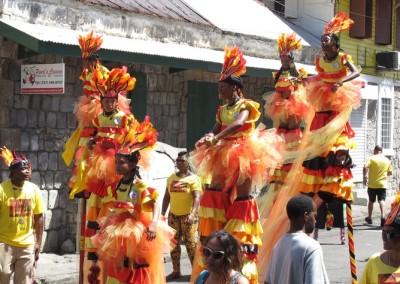
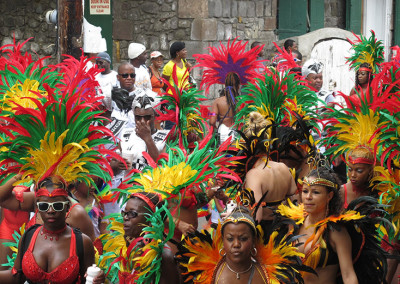
Norway: (E) A part of the Bells district in the center of the island where workers constructing the Transinsular Road in the 1940s and 1950s had their camp. Built by the Public Works Department, it consisted of long barrack buildings and kitchens. Because it was so cold to live there the workers called the place Norway. When funds for the Transinsular Road ran out in 1947, without the road being completed, at least two Carnival songs were composed celebrating the scandal. One of them began: "Sa ki twavai Norway, vini en l'office mwe..." (Those who work at Norway, come to my office...) and another: "Si ou te Norway, sa ou te ke fe?" (If you were at Norway, what would you do?) When the road was eventually completed in 1956, the camp, on the site of the present Bells government school, was demolished. Also the name, Norway, as a description of the area has generally gone out of use.
Norwood: (E) The motherhouse in England of the order of nuns, The Sisters of the Faithful Virgin, who served in Dominica from 1857 to 1937. It was the order that established the Girl's Orphanage and the Convent High School. When the Cools Lartigue family constructed their family home on Market Street in the 1860s, they called it Norwood House in honour of the religious order. It is the name that this handsome historic house still carries to this day.
Nassief: A family of Lebanese origin who settled in Dominica in the 1930's and has made a major economic contribution to the island from the mid 20th century. The patriarch of the family, Elias Nassief (1900-1987), arrived in Dominica in 1930 from Suriname. Although he had originally intended to settle in one of the French islands, he took a liking to Dominica and established a small retail-trading outlet in Roseau where his wife and older children joined him. Their younger children were born here. As his retail business expanded, Nassief was able to develop his interest in agriculture and agro-processing. With most large estates derelict, agriculture stagnant and land prices low in the 1940's, Nassief was able to buy Belfast estate on the west coast in the early 1940's and Geneva estate at Grand Bay on the south coast in 1949. He reactivated the estates expanding coconut cultivation with the intention of producing and exporting coconut oil and making by-products from coconut fiber. Some controversy arose at Grand Bay in the early 1950's from his attempts to regularise land boundaries and deal with the squatting that had developed on the estate. In 1965 he established Dominica Coconut Products with a small processing plant at Belfast. This grew under the management of his son, Phillip, to become the most successful local manufacturing company ever. Starting with a basic range of laundry and toilet soaps, DCP obtained licenses to produce international brand names and to be exclusive providers to certain cruise lines and companies such as those of Donald Trump. The number of shareholders in DCP rose to over 1000 by the time the company was sold to Colgate Palmolive in 1995. During the political disturbances of the 1970's, Nassief interests at Grand Bay and Roseau were attacked and destroyed and the government acquired Geneva estate in 1974. Besides maintaining retail businesses, the descendants of Elias Nassief have branched out into other areas of commerce including the purchase, rehabilitation an d expansion of the Fort Young Hotel, tourism promotion, insurance, real estate, duty free, vehicular sales and servicing as well as serving on government statutory boards and corporations.
Nicholls, Ralph Edgar Alford: (1893-1945). Legislator, building contractor, trade unionist. The son of the distinguished doctor Sir Henry A.A Nicholls, born in Roseau and educated at the Dominica Grammar School. He was the leading building contractor in Dominica from the 1920's, designing several of the buildings himself. These included the extension of the old Government House, the present High Court building, the old Post Office, Point Baptiste House at Calibishie and many houses in Roseau. He was a member of the legislature, representing Roseau for sixteen years, being successful in the general elections of 1928, 1931, 1934, 1937 and 1944. A few months before his death in November 1945 he helped E.C. Loblack to establish the Dominica Trade Union (DTU) of which Nicholls became the first president.
Noble: (E) The English name for one of two rocky islets situated off of Londonderry beach. The one closest to the shore was called Kashibona by the Caribs but it was renamed Noble by the British after a colonial road engineer.
Nicholls, Sir Henry Alfred Alford (1851-1926): Medical doctor, horticulturist, legislator and publicist for Dominica. Along with his mentor Dr. John Imray, and particularly after Imray's death in 1880, Nicholls bestrode the life of Dominica like a colossus and was called at times "The uncrowned king of Dominica." Born in London in 1851, he studied medicine at the Universities of Aberdeen and London (St. Bartholomew's Hospital). During his long and successful medical and horticultural career he became a Fellow of the Royal Society of Medicine, Member of the New York Academy of Sciences and a Fellow of the Linnean Society. Nicholls arrived in Dominica in 1873 as an assistant to Imray and in 1877 married Dominican, Marion Crompton. He built on the firm foundations that Imray had laid in instituting and expanding the work of the Board of Health, developing the Roseau hospital from its position as an infirmary, leading the expansion of the island health service in an island with no roads, fighting ignorance and superstition in an effort to make vaccination compulsory and in dealing with yaws, alastrim, malaria, yellow fever and other diseases afflicting the population at the time. He combined work with research and published his findings in medical journals in Britain, which attracted much attention.
Nicholls took a keen interest in the natural history of Dominica; opening up and publicising the Boiling Lake from the time he led the first recorded visit there in 1875. He guided the future King George V and his brother Prince Albert Victor to the summit of Morne Diablotin in 1880. He corresponded with the curators of Kew Gardens in England and was influential in the establishment of the Botanic Gardens in Roseau in 1891. He was a world expert on tropical agriculture publishing an influential work "A Textbook of Tropical Agriculture" which was used throughout the British Empire and was translated into several languages. He inherited land from Dr. Imray, most notably St. Aroment, and owned several estates in his own right. But Nicholls was more successful as a physician and horticulturist than he was a would-be politician. He was defeated by members of the so-called "Mulatto Ascendancy" whenever he contested an election but he was an officially nominated member of the legislature as Senior Medical Officer for many years, served on various select committees, was a magistrate for a few years and a member of the Executive Council of the Leeward Islands. He acted as Administrator of Dominica from time to time. He was a leading member of the Anglican Church and as a mark of honour he was buried next to the church in Roseau. The Alford Ward at the PMH is named after him.
Noni: (Polynesian name adopted by Caribs). Ancient peoples of Malaysia and Indonesia colonised islands throughout the South Pacific. As they made their voyages from island to island in their ocean-going canoes, they brought with them useful plants from their home islands. One of these plants was Morinda citrifolia. In the South Pacific the plant is known as Nonu in Samoa and Tonga, Nono in Raratonga and Tahiti, and Noni in the Marquesas Islands and Hawaii. It has become and integral part of the Polynesian culture. There, the noni fruit of the Morinda citrifolia tree has been used for centuries as a food and medicinal plant. Introduced into the Caribbean, the leaves were used by Caribs to wrap around rheumatic joints and the juice of the fruit is now popular as a health drink.
Nature Island: (E) An advertising slogan devised by the Dominica Tourist Board in the early 1980s to promote Dominica. Although references to "nature" had been included in the text of publicity material on the island for many years before this, the formal adoption of the term "Nature Island of the Caribbean" was then applied to all official tourism publicity. It was picked up by the private sector and informal economy so that during the 1980s and 1990s dive operators, taxi associations, tour companies and food suppliers, among others, adopted the term as part of their companies' names.
Negre: (F) The French word for 'negro', which was adopted in the Creole and applied to a wide range of related words in the plantation culture. In one meaning it denotes an enslaved person as well as a 'negro', because in the early days of colonization the two were synonymous. A free slave was a "negre affranchis". The "negres bord la mer" were slaves working on the port "by the seashore", and even after Emancipation it was applied to stevedores on the Bayfront well into the 20th century. To be a "vye negre" is to have "bad ways". "Radio negre" is street gossip. The word is likewise usually applied in a derogatory manner to various situations.
Negre-mawon: (F) The Creole term for a maroon or "escaped slave". There are place names, notably at Rosalie and behind Colihaut where maroons used to live which are still called Negre Mawon today.
Negga Grong: (E) The part of English estates on Dominica where the slaves used to live. There are still sites at estates such as Castle Bruce, Woodford Hill and Clifton, which are known as Negga Grong, Negga Yard or Negga House. On French held estates the term used was "Kai Negre", from the Creole 'kai' for 'house'.
North River: (E) The northern-most river running into Prince Rupert's Bay at Portsmouth. It was used extensively in the days of sailing vessels as a source of fresh water to service the ships of the Royal Navy, the North American whaling vessels and merchant shipping. At times when the cisterns at the Cabrits Garrison were running dry or military action was threatening, ox-carts from the Cabrits would be loaded with barrels of water from the North River.
Nowed: (F) The triangular block of wood, which sticks out at the bow of a Carib canoe. It holds the lower dugout part of the canoe to the upper 'bordage' or board that is attached along the sides of the vessel. When the Caribs were in control of Dominica the nowed was much longer and was carved in the shape of a mythical spirit to guide the fortunes of the canoe. In 1700, the French priest, Pere Labat, met a canoe-load of Caribs who had tied the arm of an Englishman killed in Barbuda to the nowed as a symbol of defiance to any who thought of attacking them.
back to top
|
O
Ober, Frederick, Albion: Author, naturalist and traveller. Between 1876 and 1878 he made an expedition to Dominica under the auspices of the Smithsonian Institution of the US. He explored, made collections of birds, and in 1880 published "Camps in the Caribbees" a book of his experiences. He describes Dominica, its birds, its fauna, natural setting and his experiences among the Caribs including their social life, appearance and language. He took the first ever photograph of the Boiling Lake in 1877. He discovered a bird at Laudat new to science and it is named after him, Myiarchus oberi, family Tyrannidae. It is a flycatcher known locally as Gwo Tete and Gob Mouch. Ober's collection of 14 Dominican birds can still be seen at the Smithsonian in Washington DC.
Ogilvy's Guest House: (E) The earliest recorded guest house for visitors to Dominica run by the Ogilvy family from the 1860s. It was located where the Sutton Place Hotel is today.
Okra: (A) A young green pod about 4 to 6 inches long, noticeably ridged and pointed with slimy seeds and flesh used as a boiled vegetable. It grows on a flowering shrub with lobed, hand sized leaves: Hibiscus esculentus (Malvaceae). The plant was brought from Africa and the name is from the Igbo word okworo.
Otrobando: A part of the village of St. Joseph. It is a place name of Dutch origin brought to Dominica by people of St. Joseph who returned from working at the oil refineries in Curacao during the 20th century. It means 'the other side' and comes from the name of that part of Willemstad, capital of Curacao, which is on the other side or 'otrabanda' of the punta or creek which divides the city. In St. Joseph it is pronounced Otrobando and denotes the other side of the river that runs through the village.
Our Lady of Fair Haven: (E) The English name for the patron saint of the Cathedral of Roseau. It originates from the French name of the first church that was built on the site by the French priest, Pere Guillaume Martel in 1730, and which faced straight down Church Street (La Rue de L'Eglise), to the landing place of the port of Roseau at what is now the Old Market. There was a strong link between the church and the coming and going of ships as a place of prayer for sailors. This was reflected in the French name "Notre Dame du Bon Port de la Mouillage de Roseau", now translated as "Our Lady of Fair Haven".
Over Gutter: (E) A part of the village of Marigot named for its position above a ravine cutting through the village. Because the origin of most of the people of this section of the north east of Dominica is from the Leeward Islands, the speaking of English Creole or Kockoy predominates. A watercourse that elsewhere on the island would be called by the French Creole speakers, ravine or cwete is called gutter in Woodford Hill, Wesley and Marigot.
Obeah: (A) A set or system of secret beliefs in the use of supernatural forces to attain or defend against evil ends. It is African in origin but on its arrival in the Caribbean certain aspects of Christian ceremonials and sacraments were integrated into its activities. It varies greatly in kind, requirements, and practice, ranging from the simple, such as the use of items like oils, herbs, bones, grave-dirt, blessed communion wafers and fresh animal blood to more extreme ingredients. Obeah men or Obeah women are names given to its practitioners. The term Pyai, from the Carib for shaman is also used in Dominica relating to the casting of spells. Origins for the word Obeah come from the Twi: o-bayo-fo (witchcraft man). From the Nembe: obi (sickness, disease), and Igbo: obi (a mind or will to do something) and the Ibibo: abia (practitioner, herbalist).
One-pot-hold-all: (E/A) A whole meal cooked in one pot. The practice was common in West Africa. The Wolof word benacin means "one pot" and "a meal made by cooking everything together".
Ouaitoucoubouli: (C) The original spelling of the Carib name for Dominica used by Father Raymond Breton in 1665, but now more popularly spelt: Wai'tukubuli. It means, "Tall is her body", alluding to the mountainous nature of the island. The construction of the word is as follows: ouaitumti = it is tall. nocoubou = my body. li = her, (Tall-body-her). If you were an inhabitant of Dominica, you were a Ouaitoucoubouliri.
Oualloman: (C) The reeds used for making the Carib baskets, tables, cassava squeezers and other utensils woven by the Caribs. By the time that the French settlers had Creolized the word, it became l'arouman, the word that even Caribs use today. The scientific name is Ischosiphon arouma. The plant is found from the Amazon River, north to Guadeloupe and was brought to the Antilles by the indigenous people some two thousand years ago. The stems are cut after having grown to a height of 12-15 feet. They are then stripped into four segments during which most of the pith is removed. They are spread in the sun to dry and during this time acquire a reddish brown colour. A black colour is obtained by putting the strands into mud holes for a few days. Creamy white strands are obtained by using the underside of the brown strips. Thus three colours are available for weaving the various traditional basket designs: brown, white and black.
Ouboutou: (C) A captain or chief among the Caribs.
Ouicou: (C) A beer made out of the fermented juice of grated and chewed manioc. Women chewed the manioc and spat it out into large earthenware jars or canalli (canari) where the enzymes in their saliva would begin the process of fermentation. When ready, the beer was then served at feasts.
back to top
|
P
Papillote: (F) A small estate in the heights of the Roseau Valley starting at Laudat and going over the cliff to Trafalgar; Also the name of the Papillote Wilderness Retreat and Nature Sanctuary situated on part of this land near to the Trafalgar Falls. The name comes from the Creole word for 'butterfly' and the French word for paper hair curlers which when wrapped on the head look like butterflies. Folklore in the area has the origin of the name coming from the joint names of two freed slaves called Pappi and Alliot, who made their homestead in the foothills below Morne Macaque after Emancipation. The origins of the well known lodge and restaurant goes back to 1961, when Anne Grey was on a six month exploratory trip to Dominica and became enchanted by this part of the beautiful Roseau Valley and purchased half an acre of land. Over the next five years she made frequent visits to Dominica from her home in Florida. In 1967, she moved to Dominica and gradually acquired more of the original estate. She began with the building of a snack-bar to serve the rare tourist hiking to Trafalgar waterfalls. The snackbar evolved into a restaurant and night club called 'L'aye Ca Fete' and under the tutelage of Cuthbert Jno. Baptiste and Anne Grey, meals were prepared for tourists during the day and live music was presented several nights a week. Bands such as "De Boys and Dem," "Swinging Stars," "The Jewels," and "The Gaylord's Power Union" developed and played there. Eventually the night club closed and the focus was shifted to nature tourism, the building of hot baths from mineral springs, a botanic garden and enlarged restaurant. In 1994, Papillote won an Eco-tourism award from Islands Magazine. It has featured in numerous international magazine articles including National Geographic's Traveller Magazine in 1996.
Pedrix: (F) Ruddy Quail Dove (Geotrygon Montana). The local name comes from the French for partridge. Its upperparts are rufous (male) to olive brown (female) and the underparts are paler brown to reddish brown in the male. It tends to live on the forest floor. In Dominica it is found mainly in the rain forest at mid or high elevations although it will also occur in coastal dry scrub woodland and may make seasonal movements from one altitude to another. Two pale buff eggs are usually laid sometime between February and August. The pedrix is a popular bird to hunt and is subject to a legislated hunting season.
Pennville: (E) A village at the extreme north end of Dominica situated along cliff tops overlooking the Atlantic Ocean and Guadeloupe Channel. The village is divided into Upper and Lower Pennville. Part of Upper Pennville is called Carib and was one of the last Carib villages. Many Pennville people are descendants of these Caribs who mixed with Africans and European settlers. After the British took over the island in 1763 the main purchasers in the area were Langford Lovell, James Morson and Duncan McIntosh, but the steep and isolated nature of the place caused them to abandon much of the lands to French smallholders prominent among whom was Jean Baptiste Demetre. His name survives in the Dimitre River which is the main stream serving Pennville. The Seaman family owned land around here also and were connected to the Harris family who owned Delaford Estate and who assisted with getting a road and school for the village.
Pagua: (C) A river, a bay, and its associated valley that cuts diagonally across the north-eastern corner of Dominica between Marigot and Atkinson. It has a large watershed of smaller tributaries backing onto the Layou River watershed in the centre of the island near D'Leau Gommier. The line of the Pagua and Layou valleys cuts across the island from the west to the northeast coasts. The Pagua River flows into Pagua Bay, which has a long sand and pebble stone beach exposed to the Atlantic Ocean. A strong undertow, caused by the river flowing out into the sea, makes the bay dangerous for swimmers.
Paix Bouche: (F) There are two parts of the island called by this name, which means, 'Shut [your] mouth'. Both are associated with steep hillside paths around the island where walkers had to stop talking to save their breath for the climb. One is in the north, on the hill between Dos D'Ane and Blenheim. The old walking road along the north coast climbed up Morne Paix Bouche to get over to Thibaud and Hiroula Bay and on to Anse Du Mai. When the workers of Blenheim and Moore Park moved to form their own community after Emancipation, the settlement that developed on this ridge became known as Paix Bouche. The other one is in the south. Here Paix Bouche is the mountain between Petite Savanne and Point Mulatre. The main bridle path that went over it was also very steep on both sides, hence the name. A dramatically cut motorable road, opened in 1998-99 now follows the line of the footpath up and over the mountain.
Picard: (F) A former plantation that dominated Prince Rupert's Bay at Portsmouth and which is now subdivided into housing, port facilities, a medical school, hotels and small agricultural plots. It first appears on the maps of Dominica in 1765 as the name of the main river in the area, River Picard or River Picart. The earliest known owner of land there was a Frenchman, Jacques Blanchard in an area still called 'Blanca' today. It is believed that Blanchard, who came from the French region of Picardy, named the river after his home district. When the British took over Dominica in 1763, lots were sold to British owners such as, Porter, Baldwin and Neave. Fifty acres around the mouth of the river was reserved for the British Navy for watering its ships. Hot springs along the riverbank were also used by sailors for bathing after ocean voyages. In 1827 Picard Estate was worked by 75 slaves who produced 111,000 lbs of sugar, 1,000 gallons of rum and 3,900 gallons of molasses that year. During the 19th century, the estate was owned by the Glanville's (who gave their name to Glanvillia), then the Davies' and then the Potters before being sold to the firm of chocolate manufacturers Rowntree & Co., at which time it totalled 1,278 acres. The site of the private Rowntree jetties eventually became the main shipping port for the north. The last single owner of the estate was the banana company Geest Industries Ltd., which subdivided and sold out its land from 1978.
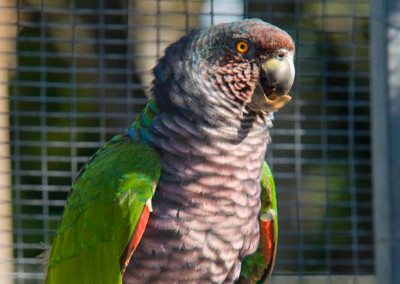
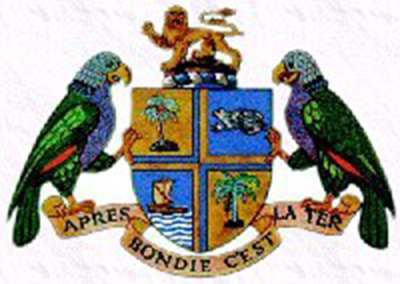
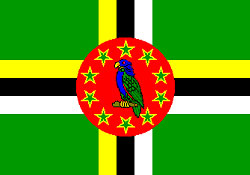
Parrots: (E) Family Psittacidae. There are two species of parrot inhabiting Dominica: The Red Neck parrot or in Creole Jaco or Jacquot (Amazona arausiaca) and the Sisserou or Imperial Parrot (Amazona imperialis), the national bird which appears on the flag and coat of arms. According to the 18th century historian of Dominica, Thomas Atwood, there once existed a macaw that is now extinct but which has been labelled by ornithologists as Ara atwoodi. It may be however, that Atwood was describing the Sisserou and referred to it as a macaw in error. The two Amazona parrots arrived on Dominica thousands of years ago from South America. Separate from the other Amazona species on the mainland they remained in their primitive form while changes took place to those on the continent. Hence the island species became unique to Dominica. It is the only island in the Lesser Antilles where more than one species of parrot survives. The Sisserou and Jaco numbers and zones of habitation decreased alarmingly into the 1980s due to forest clearance, hunting and damage caused by Hurricane David in 1979. Legislation, action and public education by the Wildlife and Forestry Service halted the decline. The Sisserou is still limited to areas around Morne Diablotin while the Jaco is repopulating central forest zones to the south.
Poirier, Charles Marie: The third Bishop of Roseau (1859-1878). A member of the Eudist Congregation, he was the most influential in the expansion of the Roman Catholic Church in Dominica after Emancipation. The two previous bishops, Michael Monaghan (1850-1854) and Michael Vesque (1856-1858), died too soon after their appointments to carry out any extensive work in the diocese which had been established in 1850. Poirier divided Dominica into twelve parishes, providing each with a church, a parish priest and an elementary school. He secured the help of the Fathers of the Congregation of Mary Immaculate (FMI) to serve here. He organized the RC churches in Montserrat (1860), St. Kitts (1867) and Antigua (1868). Once, during his term, the Roseau congregation split violently over official support for French or Breton priests as opposed to those supporting a popular Italian priest. At one point in 1869 a guard of special constables were stationed around the presbytery, an emergency was declared and the bishop had to be escorted by police from the altar to his residence.
Pemberton: (E) A family of ancient English origin long associated with the island of Nevis. From there some emigrated to Dominica in the 19th century and served in official and elected positions and owned estates. Most famous were Judge Thomas S. Pemberton and his son, Sholto Rawlins Pemberton, better known as "Judge Pemberton". He is the ancestor of all Dominican Pembertons. He was a "liberal" in politics, being a member of the Party of Progress in the 1880s. As judges they presided over several celebrated cases including Falconer vs The Queen; when Charles Falconer was wrongly sent to jail by the Speaker of the House of Assembly, and Beaurisseau vs Beaurisseau, over the ownership of Union Estate. Judge Pemberton also owned Point Mulatre, where he died in 1937.
Palms: (E) There are eight species of palms indigenous to Dominica. These palms are glu-glu, or grugru in the dry scrub woodlands along the coasts. Further inland is the gri-gri palm and the Coconay or Yattahou. In the high woods are the palmiste or Manicol and the palmiste montagne and the yanga. Another species of yanga grows in the elfin woodland on the summits of Dominica's tallest peaks. Then there is the latanier, which was once very common on the lower coastal mornes and the seacliffs but is now found mostly north of Penville. Although the coconut palm, (Cocos nucifera), is the most common type of palm seen today, it was introduced by Europeans in the 17th century from the Indian Ocean by way of West Africa.
Peltier: (F) A family of French origin long associated with the village of Point Michel and the land around it. John Baptiste Peltier was the first of the family to settle here in the 1730's. He had previously been a small-scale planter in northern Martinique, who then moved across the channel to Dominica and acquired land in the parish of St. Luke. His descendants have been prominent people in Point Michel for generations.
Picaudeau: (F) A settlement on the road between Grand bay and Tete Morne in the Parish of St. Patrick. Named after Gabriel Picaudeau, a French settler who owned 71 acres of land in the area. When the British arrived he was forced to hold the land on lease from the British Crown and this is recorded in the directory of the Byres Map of 1776.
Pipirit: (F) The Grey Kingbird (Tyrranus dominicensis). Also known in Creole as pipiwi or pipiri. This name come from the sound of the bird's call. It has a grey back and head with whitish -grey underparts. It sits on branches mainly in or near cultivation, pasture edges or along roadsides and waits to dart out at passing insects, which it knocks to death and eats. It may migrate between late September and November.
Poiree : (F) A section of the village of Point Michel in the parish of St. Luke on the road to Lofty and South Chiltern estates. It is named after John Poiree, a French settler who owned 28 acres of land in the area. When the British arrived, he was forced to hold the land on lease from the British Crown and this is recorded in the directory of the Byres Map of 1776.
Prevost, Sir George: Governor of Dominica from December 1802 to September 1805. Famous for his defence of the island during an attack by French naval forces in February of 1805. Roseau was captured and burned and the inhabitants had to pay a ransom of 12,000 pounds, but Prevost escaped across the island via Chemin L'Etang, Rosalie and the north coast and he forfeited the Cabrits. He refused to surrender the garrison and the French Squadron left the island. It was last French attack on Dominica. He was honoured by the British for his exploits.
Poirier: (F) The White Cedar tree (Tabebuia heterophylla/pallida). Also known as Poirier Blanc and in Carib: bamata. Found in the West Indies from Hispaniola to Trinidad and in Central America and Venezuela. On Dominica it grows mainly in dryer coastal areas. A fine timber tree which lasts well in sea water and is used for the ribs and built up sides of boats; it is also used in making mortars, wooden bowls, boards, and the like. The bark of the tree, used as a plaster, is said to cure corns; the leaves, chopped or whole are put on sores as a poultice.
Pont Casse: (F) A traffic intersection with a roundabout at the center of the island where the main roads leading to the north, south, east and west coasts meet. It gets its name from two concrete bridges on either side of the roundabout, which were constructed at a peculiar "broken" angle over nearby streams during the building of the Imperial Road in 1902. The angular, "casse" (broken) type of "pont" (bridge), gave the area the Creole name of Pont Casse.
Portsmouth: (E) The main town situated at Prince Rupert Bay on the north-west coast of Dominica in an area called by the Caribs: Ouyouhao, and by the French: Grand Anse. After the occupation of Dominica by the British under the terms of the Treaty of Paris, the land between the North River and Indian River was chosen as site for the capital of the island. It was surveyed and laid out in 1765 by Royal Engineer, John Simpson, with a grid design of streets around a central square (now part of Benjamin's Park), on the east side of which was to be the House of Assembly, Court House and government offices. A jail on the banks of the North River and Governor's House on the banks of the Indian River as well as a Market Place and careenage at the mouth of the river was the main part of the design. The town was named after the important naval seaport of Portsmouth in the south of England. Streets were named after leading British personalities of the day: Egremont, Queensborough, Rodney and others. But because of the surrounding swamps the place proved to be unhealthy for the first settlers due to the incidence of malaria and yellow fever carried by swamp mosquitoes. Therefore, in 1768, the decision was taken to make the capital at the small French village of Roseau instead. But the superior bay and port of Prince Rupert, where the Royal Navy came for wood and water had to be guarded, so a major garrison was constructed on the Cabrits. The town was however, an active seaport, harbouring at different times, squadrons of the Royal Navy, North American whaling ships, Confederate ships during the US Civil War, Banana boats, sea planes serving Dominica, yachts and local inter-island trading vessels.
Pwi-pwi: (C) An indigenous wooden raft made out of trunks of the Bwa Cano (Cecropia peltata) and Bwa Flo (Ochroma pyramidale) trees. They can be made without the use of nails. Used for fishing near the shore. West coast pwi-pwis usually have boards nailed around them, north and east coast pwi-pwis do not.
Port Anse Kwab: (F) A tall cone shaped islet covered in trees located about 100 meters off the north coast in the area of Anse Soldat. In English it would be "Gateway to the Bay of Crabs." A "Soldat" in Creole is a "soldier" or "hermit" crab. The small bay directly adjacent to Port Anse Kwab is called in Carib, "Womabatti." There are a lot of crabs of all sorts there as well. To enter this bay from the sea, boats have to go through a channel behind the islet. It is therefore the landmark that guides fishermen to the bay of crabs.
Port D'enfer: (F) A rock formation in the sea off the village of Calibishie named by the French because it resembled the imaginary "Gate of Hell". For centuries there was a natural arch between the two rocks through which the waves broke into the calmer water behind. But in 1954 the arch collapsed leaving the two rocks standing apart. However the effect is still one of a gate with the water rushing through it. Judging from an old map on which the rocks are marked (Thomas Jefferys 1765) the Carib name appears Mayanbaccaly.
Pottersville: (E) A section of Roseau located to the north of the city center across the Roseau River. It was originally part of Goodwill Estate, which was owned by the Potter family. As land was sold off for housing and the community grew, the area became known as Pottersville, after the family, although it was also popularly called Ballahoo Town or L'autre Bord (Lobdor).
Princess Margaret Hospital (E): The main hospital of Dominica. Built between 1953 and 1955 with Colonial Dvelopment and Welfare (CDW) Funds on the recommendations of the Moyne Commission Report of 1940 and opened in 1956. It replaced the old Roseau hospital that was located on the site of the present Government Headquarters. Named after the sister of Queen Elizabeth II who visited Dominica in 1955. It initially contained 144 beds in seven wards including a private that has since been closed. The site was wisely planned to have space for expansion in the years ahead. A Psychiatric Ward, storerooms, new laboratories, a new operating theatre and maternity wing and a polyclinic have been opened since the 1960s. After Hurricane David in 1979, Princess Margaret was patron of the UK Dominica Disaster relief Committee, which raised money for emergency relief and rehabilitation of the badly damaged hospital.
Prince Rupert Bay (E): Located along the north west coast; the largest bay and most protected harbour on Dominica. Known by the Caribs as Ouyouhao, and by the French as Grand Anse. Used by European adventurers since the second voyage of Christopher Columbus as a place for collecting wood and water. Named after Prince Rupert of the Rhine who was the nephew of Charles I of England. When Oliver Cromwell took over Britain and executed the king, Rupert and his brother Maurice escaped to the Caribbean where they engaged in privateering. They used this bay to refresh and refit their ships.
back to top
|
Q
Queen Charlotte: (E) The wife of King George III at the time when Dominica was captured by the British and ceded to Britain by the Treaty of Paris in 1763. There was an attempt to rename Roseau, Charlotteville in her honour, but the name never stuck. An estate near Newtown, Charlotte Valley, maintains the name and some older residents of Newtown still call that area of Roseau suburb, Charlotteville.
Queen Elizabeth II: (E) Up till the time when Dominica at midnight on 2 November 1978, Queen Elizabeth II was the head of the state of the island colonial rule from her accession in 1952 and under Associated Statehood from 1967. She bestowed knighthoods on three Dominicans: Sir Louis Cools- Lartigue, Sir Clarence Seignoret and Dame Mary Eugenia Charles. She visited the island three times: In 1966, 1985 and for a few minutes at Melville Hall Airport in 1994 on her way t o Guyana. Her portrait still appears on our currency because Dominica is the only republic in the OECS and also among the members of the Eastern Caribbean Central Bank that issues our currency. She is he head of the state of all the other member states and is Head of the commonwealth.
Queen's River: (E) The name given to the Roseau River by British map makers after the island was ceded to Britain by the Treaty of Paris. It was part of their effort erase French place names from use. However the French name remains in use today although the official maps still carry both names.
Queen Victoria: (E) Queen Empress in the heyday of the British Empire, she ruled from 1937 to 1901 and was monarch during the most effective period of the Anglicization of Dominica. This was brought about through the education system and constitutional changes. Many Dominicans associated her with granting Emancipation to slaves since " full free" was declared in 1838, the year after her accession. The governor's statement to the populace on that occasion made reference to them doing "what the Queen would want'. Some older Caribs associated her with the establishment of the Carib Reserve since it was declared in 1903, shortly after her death. Some places were named after her: the community of Victoria at Delices and the Victoria falls nearby. Queen's Street, named in the 18th century for Queen Charlotte, was renamed Victoria Street on the occasion of her Diamond Jubilee in 1897. A building was planned in what is now the Library Grounds to commemorate this jubilee but it was not completed until her death in 1901 and so in 1902 it was opened as the Victoria Memorial and served as reading rooms before the Public Library was built. It is now the sales office of DBS Radio, but the initials VRI can still be seen on the gable end: "Victoria Regina Imperiatrix". A huge portrait of her, painted with the subscriptions of Dominicans of all walks of life, hangs in the Dominica Museum. Her birthday, May 24, was celebrated every year long after her death as "Empire Day".
Queensborough Street: (E) A street in Portsmouth named after the Earl of Queensborough, an important member of the Board of Trade in England at the time when plans were drawn up for Portsmouth to be the capital.
back to top
|
R
Rollo, Lord Andrew: (1703-1765) 5th Baron Rollo in the peerage of Scotland. He led the British land forces in the attack and capture of Dominica on 6 June 1761 and was made Commander-in-Chief of the island. From 1757 he was fighting for the British in the Americas during the Seven Years War. He saw action in New York, Cape Breton Island, Sorel and Montreal. On 3 May 1761 he sailed with his regiment from New York to the West Indies where he commanded the land forces at the attack on the French settlement of Roseau on 6 June. After the capture he was made Commander-in-Chief of Dominica before the island was ceded to Britain by the terms of the Treaty of Paris in 1763. During this period he took a prominent part in the British capture of Martinique and in the campaign against Havana, Cuba in 1762. He died in England in 1765. On Dominica, his name was given to Rollo's Head which had been called Pointe Ronde by the French, but the French name is still more used today. His name was also given to Rollo Street in what was to be the British capital of Dominica at Portsmouth and this street name still survives.
Roseau: (F) The capital of Dominica, named after the 'roseaux' river reeds that grew along the banks of the river and over the area when the first French settlers arrived there. The Carib name was Sairi. The city is built on a fan-shaped river delta made up alluvial deposits brought down by the river and the debris of pyroclastic flows from the volcano at Morne Micotrin (Macacque), which stands at the head of the Roseau Valley. Amerindian people first occupied the site and were followed by French woodcutters and then by more permanent French settlers who established a sizeable village with a church by 1730. Roseau was attacked by British forces on 6 June 1761 and captured. The British took over but French forces recaptured it 7 September 1778. The French attacked the town again in 1805 when it was entirely destroyed by fire. Reconstruction was slow in difficult economic times. Only in the 1950s did the town begin to expand beyond its 19th century boundaries as country people came in on the newly constructed roads across the island for education and jobs. Now Roseau and environs is packed with 30% of the population of the whole island.
Rosalie: (E) This estate is situated on the east coast on banks of the Rosalie River. It was one of the largest estates on the island, totaling 2,081 acres, but since the 1960s much of it has been sub-divided and sold off. It produced sugar, cocoa, limes, bananas and coconuts at various times in its history. The ruins of an aqueduct and sugar works are still standing and the site of the old estate house can be seen on the hill above the works near to the modern estate house. The first British owners included Governor William Stuart and in the 19th-20th century the Johnson family. A maroon attack on the estate buildings under the maroon chief Balla took place here in December 1785. After emancipation a village developed around the estate yard and there was, for a time, a police station, school and church, but when new owners, Messrs. Leach and Tabor, took over in the 1950s the land was reclaimed and the villagers had to dismantle their houses and disperse to the settlements at Grand Fond and Riviere Cyrique. The church was abandoned and fell into ruin, but in the 1990s it was restored and is now the site of the FMI Retreat Centre.
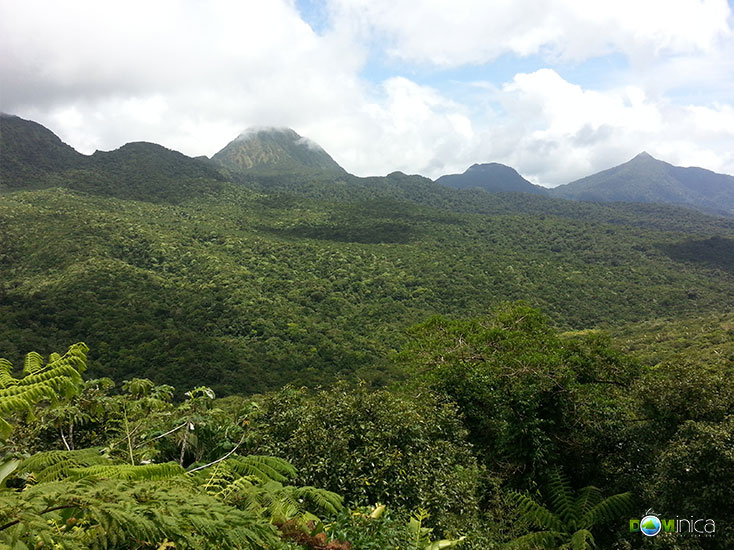
Rainforest: The largest of the six vegetation zones on the island. The tall broad-leafed evergreen rainforest is generally found at altitudes between 1,000 and 2,500 feet above sea level, although on the east and north of the island , the rainforest can begin at about 500 feet. The high rainfall and difficulty to access has generally saved some key areas, while the establishment of the Northern and Central Forest Reserves in the 1950s and the Trois Pitons National Park in 1975 has preserved other parts. It is the largest stand of rainforest in the Lesser Antilles. This type of rainforest is most important for watersheds, maintenance of rivers and provision for a reliable water supply. The rainforest is composed of a number of distinct layers from the forest floor to the tree top canopy. Micro-climates at at each layer supports varied animal and plant life. There are numerous species of dominant trees as well as thousands of species of smaller plants interacting in a complex ecological web. During the twentieth century the extension of roads and farms, particularly from the 1950s, has reduced the rainforest area by thousands of acres, particularly in the large Layou Valley watershed and on the northeastern foothills of Morne Diablotin.
Rastafarians: (A) Members of a group whose lifestyle, ideology and religious beliefs emerged in Dominica during the early 1970s influenced by the growth of the movement across the Caribbean from its roots in 1920s Jamaica. The Pan-African teachings of Marcus Garvey and the "folk" religions of rural Jamaica fused with the inspiration of Ethiopia as a symbol of an unconquered Africa. In 1930 Ras Tafari Makonen was crowned the 111th Emperor of Ethiopia in a line traced back to the union of King Solomon and Queen Makeda of Sheba. His new title was His Imperial Majesty the Conquering Lion of the Tribe of Judah, Elect of God. Tafari took a new name: Haile Selassie - 'Power of the Holy Trinity.' Several preachers in Jamaica began to pray to Selassie as the living God and the hope of African redemption. Worshippers of Selassie became known as Ras Tafaris or Rastamen. The Rastas began wearing long hair and beards because of a teaching in the Old Testament, also followed by orthodox Jews, that no razor shall touch the hair of the faithful. The corruption of society and the police, who were seen to protect it, was 'Babylon', and nature, the countryside and future peace was 'Zion'. The belief in pursuing a life close to nature, spurning imported and processed foods and depending more on vegetables, 'I-tals', had an influence even on non-rastas. Although the whole lifestyle, beliefs and appearance associated with Rastafarianism is widely accepted today, there was fierce reaction from the social and political establishment of 1970s Dominica.
Rhys Jean: (1980 - 1979) The pen name for Dominica's most famous author who was born in Roseau on 24 August 1890 and was christened Ella Gwendolen Rees Williams. Her father was a Welsh doctor working here and her mother was one of the Lockhart family who owned Geneva Estate at Grand Bay. She was educated at the Convent High School and left for England when she was sixteen years old. She went into the theatre for a short time but began writing in earnest in 1922, publishing her first book in 1927. By then she had married a Dutch poet, the first of her tree husbands and lived a rootless wandering life in Europe mainly in London, Paris and Vienna. Her early novels and short stories reflected this lifestyle. She only returned to Dominica once in 1936. Her literary triumph was the novel "Wide Sargasso Sea" published in 1966, which won literary awards, and which, like parts of her other books, drew on her memories of Dominica.
Rivers: It is a popular saying that Dominica has 365 rivers "one for everyday of the year". But in actual fact the 18th century historian of Dominica was more accurate when he wrote, "there being upwards of thirty fine rivers in the island, besides great numbers of rivulets of excellent fresh water". A count around the coast of Dominica indicates that there are ninety streams varying in sizes that pour into the sea. Many of the bigger ones have innumerable tributaries flowing into them. The Layou River is the longest, drawing water from the largest watershed in the centre of the island. Pagua, Melville Hall, Rosalie, Roseau, Castle Bruce, Hampstead, Londonderry, Geneva, and River Blanche rank among the largest. All of them have experienced depleted volumes of water over the past fifty years due to deforestation.
River Estate: (E) An estate adjacent to Canefield on the west of the island once totalling some 233 acres. It produced sugar, rum, and later limes and had one of the last big water - powered crushing wheels in operation. For this water was channelled by canal from Boeri River. In 1872 it was worked by 81 slaves and produced 97,500 pounds of sugar, 920 gallons of rum and 3,600 gallons of molasses. The estate was owned by John W. Myler in the 19th century, and from the early 20th century by A.C. Shillingford. In recent years large portions of the estate has been subdivided and sold as housing lots, while the old factory site was occupied by Marinor Enterprises.
Railway (E): The only railway that existed on Dominica was built on the lower slopes of Morne Diablotin near to Portsmouth. The Forest Company Limited was founded in 1910 with the Blandly family being the main shareholders. The land in the interior is still called Blandly today, although most people now say "Brandy". The purpose of the railway was to extract timber from Blandly Ridge and process at a sawmill near to the mouth of the Indian River. The railway was designed to bring the giant logs out of the rainforest to the coast. Several bridges and viaducts were constructed across streams and ravines and the remains of some can still be seen in the bush. Like all of the timber companies in Dominica before and since, Forest Ltd. went bankrupt shortly afterwards and folded in 1913. The small steam train was sold overseas and the rail lines were ripped up and stolen for house joists and reinforcing concrete around Portsmouth. The English shareholders sold out to local partner-merchants, among them Green, Shillingford and Baron and their descendants still own the company lands today. The sawmill and railway depot is now the site of the Portsmouth filling station.
Reposoir: (F) An old French coffee estate at the extreme north end of Dominica overlooking the Guadeloupe channel. It gets its name from the French word meaning to repose or to rest. By the 1920s it was owned by H. Seaman in combination with the estates of Grand Fond and Delaford, which together amounted to 865 acres. These estates were divided among his daughters, with Reposoir going to one of them, and whose descendants, the Grells still own the estates. Since the middle of the 19th century the reposoir estate house, a modest traditional wooden building, stood overlooking a splendid view of the islands of the Saintes and Guadeloupe. It was destroyed by by fire on the night of 12 February 2002. It had been many years since anyone had lived there permanently. It was one of the last of its type and the estate is still without a motorable road, electric power or public water supply, giving it an atmosphere unchanged for centuries. It is reached by walking along the Reposoir to Capuchin track from Au Jen near Penville.
Rose, Lime Company: (E) L. Rose and Lime Company was one of the most successful agricultural companies ever based in Dominica. It contributed to the most prosperous period that the island experienced at the height of the green lime trade from 1903 to the mid 1920s and continued to operate here until 1980. The company was first established at Leigh, Edinburgh, Scotland in 1865 by Mr. Lauchlan Rose. It manufactured the world famous "Roses Lime Juice Cordial' and lime marmalade. L. Rose & Co. purchased Bath and Elmshall estates in Dominica from William Davies in 1891 and converted the old sugar factory to the processing of limes. In 1906 the company started the manufacture of calcium citrate and in 1921 a factory was erected at Bath Estate for the production of citric acid crystals. Rose and Co. was the main buyer of limes and lime products from across the island. After World War II, it held Picard Estate for some years and then purchased Soufriere Estate (1950), St. Aroment (1958) and Canefield and Wallhouse in the 1960s. In 1957 the company was bought over by Schweppes Ltd., the largest single group of soft drink manufacturers in Britain, which in turn merged with Cadbury, the chocolate manufacturers. In 1960 Roses entered the shipping agency business with offices on the Bayfront. At Soufriere there had been significant upgrading of equipment including a jetty for shipping and a cableway or "coulees" fro getting limes from Morne Acouma across the valley to the factory. The villages of Soufriere and Scott's Head were heavily dependant on the company for employment. In 1974 a large grapefruit and orange juicing plant was opened at Bath Estate, but within months the factory proved to be a failure. By 1978, changes in the world economy, political upheaval here, management problems and a concentration by the parent company on more significant investments in Ghana and Cameroon in Africa caused L. Rose and Co. to pull out of Dominica. Already St. Aroment was being subdivided for housing , Canefield, Bath and Elmshall estates were sold to government and Wallhouse was sold to Leo Emanuel, while Soufriere Estate was handed over to the government as a parting gift in 1980.
Roseaux: (F) (Arundo saccharoides) This tall reed grows throughout tropical America. It is found on Dominica mainly along stream banks and its French name was given to the capital of the island. Among the Carib/Kalinago people the name was boulea, "arrow pierce' and mabulu. It was used in numerous ways. The hard main stem was used for the sides of houses and for lathes or thatching rods for roofs. The fan-shaped leaves were used as thatch . The young shoots of unopened leaves were used for shampoo. The light, straight, mature upper stems, on which the flower grew, were used for shafts for arrows. The young main stem was stripped and used in certain parts of basket making. The midrib of the leaf is also peeled, bleached and sun dried to be plaited and sown for the making of hats. Recently some people have returned to using the main stem of the roseaux reeds as decorative work in hotels, bars and guesthouses. Much could still be made of this product today.
Rouge, Morne: (F) Morne Rouge is an old French estate situated at the extreme southern end of the island behind Soufriere on a steep hillside looking towards Martinique Channel. It was owned from the beginning of French colonization in the 1720s by the Bellot family and only changed owners from the 1950s. The stone and wood estate house is probably one of the oldest surviving on the island. The estate produced sugar, coffee, cocoa and limes. These were grown on dry stone terraces built into the mountainside. Its name comes from either the Gommier Rouge (Bursera simaruba) which grows in profusion in the area, or from the fact that it looks across to the Morne Rouge in Martinique.
Rat, Joseph Numa: A surgeon and general medical practitioner who worked in Dominica from 1890 to 1902, and who made an important study of the "Carib language" as it was spoken at the time. Dr. Joseph Numa Rat, M.R.C.S., had previously been stationed in West Africa. At first he was posted here as medical officer for the Windward District and was based at Marigot. His district included the Carib Quarter, as it was known at the time, and he became interested in recording the disappearing "Carib language". He took language notes from his Carib patients and eventually compiled a report entitled "The Carib Language as now spoken in Dominica', which was published in the Journal of the Anthropological Institute in Britain in 1897. This study was important in showing modern linguists that what was called the "Carib language" was really a branch of the Arawakan language. He also produced papers for medical journals on sleeping sickness and the skin disease called "yaws" which was very common in Dominica at the time as well as Filariasis, which can cause a swelling of the legs called "elephantiasis". During the latter part of his service in Dominica he worked with Dr. H. A. A. Nicholls at the Roseau Hospital where, in 1901 alone, he amputated 15 legs of people suffering with elephantiasis. From Dominica, Numa Rat went to St. Kitts and then transferred to Nevis in 1906.
Rwa Bwa: (F) Roi Bois, Capitaine Bois, Maitre Bois; the Mistletoe family Loranthaceae. It is a light-green-leafed parasite that grows on trees, frequently mango and guava trees. The Caribs used the leaves as one of many ingredients of a ritual bath, which was taken to combat sickness caused by the casting of spells, piai, by a shaman or boye.
Ratchette: (F) From the French raquette; Prickly Pear Cactus, (Opuntia dillenii), a member of the family Cactaceae. Most common on the drier parts of the leeward coast, the fruit of this cactus was eaten and used as a dye in cooking. On the wetter windward coast the ratchette seldom sets fruit. The Caribs used the fleshy joints of the plant in their medicinal treatment of an enlarged or painful spleen. The Carib name for the cactus is bata. A settlement on the west coast where much cactus grows is called Morne Ratchette. In Carib times the area was called Batali also after the bata cactus. An estate and bay nearby are still called Batali today.
Rawle, Cecil, Edgar, Allan: (1891-1938) Lawyer, member of the Legislative Council, newspaper proprietor, pioneer of Caribbean unity. Cecil Rawle was born in Roseau on 27 March 1891, of Trinidadian parents, his father being the head of the local branch of the West India and Panama Telegraph Company, the precursor of Cable and Wireless. Rawle was educated at the Dominica Grammar School and Codrington College, Barbados and graduated in law at the Inner Temple, London, in 1913. He practiced law briefly in Trinidad and Grenada before returning to Dominica. At that time there was no elected representation in Dominica and Rawle led a campaign to bring back the vote, founding the Dominica Representative Government Association. In 1925 its goal was achieved, a new constitution was granted, and Rawle represented Roseau in the first elected legislature in the 20th century. Besides practicing law he owned the Dominica Tribune newspaper, which he incorporated with the Dominica Guardian in 1924. He however clashed with his main reporter J. Ralph Casimir over Casimir's support of Marcus Garvey's UNIA Pan-Africanist Movement. Finding that the elected minority in the legislature was restrictive, Rawle led a boycott of the legislature in 1931. The following year he chaired 'The Dominica Conference', the first regional meeting to be initiated by Caribbean leaders themselves to discuss the future of the region. The delegates called on the British government to grant greater representation and self-government. Another constitutional change in 1936 made some limited changes towards achieving their demands. In 1937 Rawle accepted the position of Attorney General of the Leeward Islands, based in Antigua. Some saw this as a sell-out to a British ploy to absorb an agitator, but Rawle's growing family and financial commitments had much to do with his acceptance of the post. Within a year however, he died suddenly in Antigua on 9 June 1938 at the early age of 47. Yet he had accomplished much within those years, particularly as a pioneer regionalist in the ranks of A. A. Cipriani of Trinidad and T. A. Marryshow of Grenada.
Roucou: (C) (Bixa orellana) Annatto, a shrub native to South America and widespread on the islands. It is used mostly as a vegetable dye for food. In the past annatto was used by the indigenous people of Dominica mainly as a protective ornamental paint and as warpaint on the body. As a body paint it was sometimes mixed with powdered charcoal to darken its colour. Mixed with oil it also served as a sun and insect lotion. The whole body was covered because of its property of protecting the skin from insect bites and from the ravages of the sun. The roots were sometimes used to flavour meat or sauces and dried roucou sticks were used as fire drills for making fire. The leaves were used in ritual baths.
Roman Catholic Church: Since the arrival of Columbus, the Roman Catholic Church has had an important influence on Dominica. The island was named for Sunday, the day on which it was sighted, 'Dies Dominica': The Day of The Lord. Latin hymns of praise starting with 'Salve Regina' were sung off its coast in thanksgiving. But little direct impact of the church was made for the next 150 years until French missionaries of the Dominican Order led by Fr. Raymond Breton began a mission among the Caribs. He said the first Mass at Vieille Case in 1646 and built the first church at Colihaut in 1653. Franciscans and Capuchines came later but had no lasting impact. It was with French colonization that the RC church was firmly established under the Jesuits at Grand Bay and by Fr. Martel at Roseau, who built the first church there in 1730. The RC mission under slavery followed the directives of the French Code Noir, whereby the enslaved were to be instructed in the faith and participate in the Mass and other ceremonies of the church, unlike the early Protestant attitude which forbade participation. On the capture of Dominica by the British, the Crown allowed the RC to continue as before, but Catholics wishing to participate in government and hold official posts had to take certain oaths denying aspects of their faith. This practice was abolished with Catholic Emancipation in 1829. In 1764 ten acres of Roseau had been granted on lease to the RC church and then was given in freehold in 1864, which it still holds. Great expansion of the church occurred after full Emancipation in 1838 particularly from 1850 when Roseau was established as a diocese. Under the first bishops, Monaghan, Vesque and especially Poirier, parishes were established and the first large rural churches constructed. Religious orders from France (FMI) and later Belgium (Redemptorists) came to serve all over Dominica. In 1857 the first nuns arrived to begin a school for girls and an orphanage. During the 20th century church building continued, schools at Pointe Michel and Portsmouth were established, the St. Mary's Academy and later SMP, provided education for boys. Nuns moved into providing health and welfare services. The Credit Union movement initiated by Sister Alicia has become the equivalent of a national banking service. The ordination of local religious effectively began in the mid-century and has produced two Dominican bishops, Bishop Bowers and Archbishop Felix. The effects of Vatican II from the 1960s and the introduction of the Charismatic Movement from the 1970s, the effect of the US-influenced fundamentalists on membership, the need for vocations to support the church and the increased dependence on lay people are some of the features of the church at the beginning of the 21st century.
Rodney, Lord George Brydges: (1719-1792) British admiral, victorious commander of the Battle of the Saintes, fought off of the north coast of Dominica. George Brydges Rodney was born in London in February 1719 and entered the navy in 1732 at the age of 13. He rose quickly through the ranks serving mostly in Newfoundland, along the Canadian coast and defending the North American colonies from the French. In 1761 he was appointed Commander-in-Chief of the Leeward Islands station where in 1762 he led the capture of Martinique, St. Lucia and Grenada. In 1771 he was made Commander-in-Chief of Jamaica and from 1779 he again served in the Leeward Islands. Coming out from England with a fleet in December 1781 he waited in St. Lucia to keep track of the French fleet anchored at Martinique under the command of Admiral Compte de Grasse. As the French set sail for an intended attack on Jamaica, Rodney gave chase and cornered the fleet off Dominica on 12 April 1782. A sudden change in the wind off Capuchin Point gave him a chance to 'break the line' of French ships and he scored a major victory, seven ships and De Grasse himself being captured as well as many other vessels damaged. In England he was raised to the peerage as Baron Rodney and given a pension, dying in 1792. In Jamaica a memorial statue covered by a huge cupola was erected at the center of Spanish Town in his honour. In Dominica a street in Portsmouth was named after him, (Rodney Street, also known as 'La Rue General') and a point on the west coast, known to the French as Point Tarreau, was renamed Rodney's Rock. The victory at the Battle of the Saintes changed the fate of Dominica, because at the Treaty of Versailles (1783) Dominica was handed back to the British. Had Rodney failed, Dominica would probably have remained French.
Rodney's Rock: (E) The name of a rocky point along the west coast north of Jimmit that is composed of fractured volcanic lava ejected from the Trois Pitons volcano. The French called it Pointe Tarreau after the Carib word, Tarreau, which was their name for both the place and the White Tailed Tropicbird (Phaethon lepturus) that nests in the nearby cliffs. The British named it Rodney's Rock following Admiral George Rodney's victory at the Battle of the Saintes in April 1782. There is a local legend that the French, who occupied the island at the time, had placed lights upon the rock so as to disguise it as a ship anchored in the dark. This was done in an effort to delay Rodney as he sailed up the west coast in pursuit of the French fleet. The story goes that Rodney was indeed diverted by this trick and hung around all night pounding the supposed ship with cannon shot, only to find at dawn that it was merely a rock. As good as this story sounds, there is absolutely no proof that it actually happened and in any case at dawn Rodney was off of the Cabrits angling for an engagement with the French fleet.
back to top
|
S
Salisbury:
(E) An estate and a village along the west coast that were named
by the British in reference to the city of Salisbury in the county
of Wiltshire in the south of England. The original Carib name
for the area was Baroui and it is still used in Creole to refer
to the place. However, as Dominica became more Anglicized during
the 20th century, the name of Salisbury began to appear more often
on official documents and maps and by the 1960s it had taken over
from the folk name of "Baroui". The original Carib village
existed on the flat land near the sea where the cemetery is now
located and when graves are dug, small broken pieces of pre-Columbian
pottery are still brought to the surface. The early post-emancipation
village developed on the narrow stony ridge on the boundary between
Salisbury Estate and Grand Savannah Estate. It was for much of
the 20th century a settlement of thatched huts made of gaulettes
perched on bare stone. The Catholic Church was completed in 1929,
being built using cut stone from quarries in the area. The banana
industry changed the village from the 1950s and 1960s when feeder
roads opened up access to agricultural land in the hills behind.
For a time the "banana boats" would anchor at Salisbury,
as well as at Roseau and Portsmouth, to collect fruit. When private
land at Grand Savannah became available for purchase in the 1980s
the village suddenly expanded northwards. The new housing lands
were favoured by retired Dominicans who had emigrated to England
in the 1950s and returned in the 1980s and this was reflected
in the standard of house construction. The estate situated in
the valley grew and processed sugar up to the 1880s when Vincent
Dupigny owned it. It is now owned by the Vidals.
Sibouli: (C) Two types of fish and the name of two places
on the island. The scientific name for the two types of fish,
which are of the same genus described as Sibouli are: Melichthys
piceus and Melichthys niger. The place names exist as parts of
the villages of Point Michele and also of Massacre. At Point Michele,
Sibouli is the area in the southern section of the village, south
of the Roman Catholic Church, in the vicinity of a large dry ravine
that crosses the main road. At Massacre, Sibouli is that section
of the village on the hill between the Massacre River and Ravine
Giraud up a narrow village road that continues as a footpath into
the hills. It is thought that the names may apply to the original
Carib names for these villages, since the Kalinago/Carib people
often gave names to places where there were specific wildlife
and natural resources (Tarreau: seabirds, Mahaut: trees for rope).
Therefore the use of Sibouli at these two places may refer to
the prevalence of Sibouli fish in the sea off of these two areas.
Salybia, Salibia: (C) The main community in the Carib Territory
forming the administrative centre of the district where the school,
health centre, Roman Catholic Church, police station and Carib
Council Office is located. It is also the original centre of the
first 134 acres of land reserved for the Caribs by the British
from 1765 and delineated on the Byres Map of 1776. It lies mainly
in a valley that opens onto a rugged wave-swept shoreline is one
of the main beaching places for canoes. The Roman Catholic Church
was granted 14 acres of the original land in the valley in 1864
by the British government for the establishment of a church, a
presbytery and cemetery. The government subsequently used some
of this land also for erecting state buildings such as the school
and health centre. Salybia was the scene of the "Carib War"
in 1930 when a confrontation between Caribs and police related
to the seizure of smuggled goods spilled over into a major incident
whereby two Caribs were killed, a warship of the Royal Navy, HMS
Delhi, was called and flares were fired and searchlights used
to frighten the Caribs into submission. A Commission of Enquiry
was called to investigate the incident the following year. The
name, Salybia, is also found on the east coast of Trinidad and
it is believed was introduced from the Orinoco region by the indigenous
people.
Saint Sauveur: (F) A village situated on the shores of Grand
Marigot Bay on the east coast that is partially protected by a
coral reef. This provides a sheltered landing place for fishing
boats. An Amerindian village existed here from 2000 years ago
on the site of the present government school and playing field.
Arawakan-speaking travellers from South America settled here.
The last group to live in the area was the Kalinago/Caribs and
many families in Good Hope, Saint Sauveur and Petite Soufriere
are descendants from these first people who mixed with French
and Africans who arrived later. The Grand Marigot estate was established
here from the 1770s and the foundations and the stone entrance
stairway of the old estate house are still standing. However the
watermill and sugar factory across the river were destroyed by
hurricanes and decay long ago and the village health centre. now
stands on the spot. In 1861 it was still called Grand Marigot
Estate and was owned by the heirs of William Davies. The village
gets its name from the establishment of the Roman Catholic parish
of Saint Sauveur (Saint Saviour's) that was founded by Bishop
Poirier in 1866. The parish of Saint Sauveur extended from the
Rosalie River but included Grand Fond, and went as far north as
the Madjini River on the boarders of what was then called the
Carib Quarter. The first priest of the parish, Fr. Ronard (FMI),
was installed on 3 March 1872. By 1869 the estate was owned by
the Bishop of Roseau and was renamed Saint Sauveur Estate. The
church sold off or rented many small plots of land to the people
in the area. In 1924 the estate still had 447 acres and was owned
by the heirs of A.C. Mondesire; later in the 20th century it belonged
to the Shillingford family. Although the name of the parish was
French, it was often written as it was pronounced in Creole: San
Sauveur, and this spelling has become increasingly accepted, even
in official matters. A motorable road reached Saint Sauveur in
1965 and other facilities such as telephones, piped water and
the construction of a new school followed soon afterwards.
Schelfhaut, Philip: (1850-1921) The fifth bishop
of Roseau. Bishop Schelfhaut was born in Belgium and was a member
of the Redemptorist Order. He was Bishop of Roseau from 1902 until
his death in 1921. He had served as a priest in St. Thomas before
arriving here along with other Redemptorists in 1902. This order
joined the FMI, Sons of Mary Immaculate that had been serving
here since 1872. Much construction of church buildings was accomplished
under Schelfhaut: the Bishop’s House, the Roseau Presbytery
and the Convent Primary School on the site of the present Dominica
Club. Between 1906-1907 the first of the present Convent High
School buildings were completed. The St.Gerard’s Hall was
constructed in 1910. The Cathedral, started 100 years before,
was completed in 1916. In 1907 the bishop commenced the publication
of the “Ecclesiastical Bulletin,” a monthly journal
of information and instruction for the Catholics of Dominica and
the diocese. In 1909 he established the “Dominica Chronicle”,
which, after changes in ownership since the 1970s, is still with
us today. He spearheaded church organizations such as the Solidarity
of the Children of Mary for young women in 1904 and the St.Gerard’s
Guild for boys and young men in 1910. The Hall, built in the same
year, housed a parish library, games room, skills training workshops,
and a stage and auditorium that served as the main community center
of the island into the 1970s. The St.Anthony’s Society was
set up in 1909. It was Dominica’s first insurance society
providing for medical attention, medicine, sickness allowance
and burial expenses. Bishop James Moris succeeded Bishop Schelfhaut
in 1922.
Scott, George: (1722 - 1770) Lieutenant Governor of Dominica
from 1764 to 1767 at the time when the island was a unit of the
British colony of the South Caribbee Islands. This five-island
colony (the Windward Islands and Tobago) had its headquarters
in Grenada under the Governorship of Sir Robert Melville. Colonel
George Scott of the 40th Regiment was born in New England and
provided notable leadership to troops in Canada during the British
capture of Louisbourg in 1758 and of Quebec the following year.
On June 6 1761 at Roseau, he participated in the capture of Dominica
from the French and remained with the army of occupation. He began
directing the construction of a military defence system for the
island and established the first fort on Cachacrou Point, now
still called Scott's Head after the Lieutenant Governor.
Scobie,
Edward: Academic, author, broadcaster, newspaper editor,
politician, Mayor of Roseau. Vivian Edward George Dalrymple was
born in Roseau and educated at DGS. He played cricket and football
for the island. He left Dominica for England during World War
II to join the Royal Air Force and stayed on after demobilization
for twenty-three years. As a working journalist in London, where
he assumed the surname of Scobie, he became correspondent for
the Chicago Defender, Ebony and Jet
magazines, all belonging to Johnson Publications of Chicago for
which he was the UK correspondent. 1961-1963 he edited Flamingo,
a British Pan-African literary magazine. He contributed to several
BBC Caribbean programmes as broadcaster and scriptwriter on radio
and television. He returned to Dominica in the mid 1960s to take
over the editorship of the Dominica Herald in
1965 from Phyllis Shand Allfrey who established her own paper,
The Star, that year. Together and with
Stanley Boyd, editor of The Chronicle,
they led a newspaper editors’ protest at the passing of
the Prohibited and Undesirable Publications Act in July 1968.
As part of the group of “Freedom Fighters”, this led
to the formation of the Dominica Freedom Party. Scobie was elected
to senior positions within the party and in 1971 led the DFP to
victory in the Roseau Town council elections and became Mayor
of Roseau. By 1972, Scobie had become weary of the narrow confines
of local politics and the parochial attitudes in Dominica and
turned to the US to launch a new career in academia. He taught
first as an Associate Professor in the African-American and Political
Science Departments at, Rutgers, the State University of New Jersey.
He also taught at Princeton University and the City University
NY. His major work is the book “Black Britannia:
A History of Blacks in Britain”, published
by Johnson Press (Chicago and London) in 1972.
Secondary
Forest: (E) What was once virgin forest on Dominica that has
been disturbed by agriculture or the felling of timber at some
time during the last five hundred years and which has then been
abandoned and taken over by the forest once more. Large tracts
of Dominicas forests are therefore secondary forest. Whole
areas, such as the Cabrits, were once cleared of trees and, since
the 1850s, the forest has reclaimed the headland. Thousands of
acres of abandoned plantation land are now in secondary forest
at different stages of re-growth. The first plants to reclaim
abandoned land are razor grass, tree ferns and balizier, then
Bwa Cano and Bwa Flo, and then a variety of forest trees growing
back gradually to mature forest once more. Some 64% of Dominicas
forested lands are actually under private ownership, much of it
secondary forest.
Seignoret, Sir Clarence Henry Augustus: (1919-2002) President of Dominica, Cabinet Secretary, Civil Servant. Born in Roseau 25 February 1919, son of Mr. Clarence A. Seignoret and Mrs. Violet Seignoret (nee Riviere). Educated at Miss Potter's School, Convent Prep, St. Mary's College in St. Lucia and the Dominica Grammar School. He entered the clerical service in 1936 and began a distinguished career in the Public Service. He served in the Agricultural Department based in the Botanic Gardens and in several other departments in positions such as clerk at the Government Marketing Depot, Excise Officer, Administrative Steward of the Roseau Hospital and Administration Clerk responsible for cases referred by the department of Social Welfare. In 1950 he married Judith Laronde of La Plaine and together they enjoyed a long and happy marriage that bore them two sons, Joey and Gilbert. He became Principal Assistant Secretary in the Ministry of Social Services in 1956 when the Ministerial System of government was first introduced. In 1958 he was granted a scholarship to Oxford University to pursue an international public service course. Shortly after his return he became Principal Secretary in the Ministry of Trade and Production in 1960. He attended the 1966 Constitutional Conference in London with Chief Minister Edward Le Blanc and others, which agreed on the 1967 Constitution for Associated Statehood with Britain, the first stage towards political independence. He was the first Secretary to the Cabinet from 1967 into the 1970s. From 1966 to 1983 he also acted from time to time in the place of the Administrator, Governor, and after independence in 1978, in place of the President. In 1966, during a visit by Queen Elizabeth II he was awarded the Order of the British Empire (OBE). Seignoret was sworn in as the 3rd President of Dominica in October 1983 and served two full five-year terms until 25 October 1993. Knighted by Queen Elizabeth II during her visit to Dominica on 25 October 1985, Sir Clarence was also awarded the Dominica Award of Honour by the State in 1994 on the completion of his two terms as President. Other honours included the Order of the Liberator granted by Venezuela in 1987 and Knight of Malta in 1992. From the 1960's, in his spare time, he worked a small farm on land near Pont Casee. He died on 5 May 2002.
Senhouse: (E) A section of Castle Bruce village that was named after Joseph Senhouse, an English absentee planter who owned the land in the area during the 18th century. He called the estate, Lowther Hall, but as was the custom in Dominica, all the people round about called it after the owner himself. Senhouse only paid a few visits to his estate, living most of the time in Barbados and England. One visit in 1776 is recorded in his diary, which has been published.
Sensay
Costume: (A) A costume of West African origin worn at Carnival
time in Dominica. It is made of frayed rope and other fibrous
material such as pounded leaves of the agave, 'langue beff' (Furcraea
tuberosa) that grows mainly on the west coast. The material is
tied around the body in layers so that it cascades from the head
to the feet. A mask is usually worn on the face and cow horns
form the headpiece. Sensay costumes are also made of strips of
paper, cloth, frayed plastic sacks and dry banana leaves 'pai
fig'. They are similar to costumes used in West African tribal
ceremonies. The word comes from the Twi language, senseh, which
is a type of fowl with curled or ruffled feathers. The costume
is named after its resemblance to the fowl, which also has special
spiritual properties among the Twi people.
Seekwee:
(F) A small factory for the production of sugar of a type operated
by small farmers, once called peasant proprietors. The word comes
from the French, Sucrier, a sugar-making factory. These small
seekwees existed all over Dominica. Each comprised a crushing
mill turned by cattle that was called a Moulin and a rack of three
boilers or taeches, also known as cappas in which the sugar cane
juice was boiled until it crystallized. When limes gained prominence
in Dominican agriculture, the seekwees were easily adapted to
crushing limes and boiling the juice in the taeches so as to concentrate
it. Even so these sites were still called seekwees. By the 1960s
most of them had collapsed through disuse and then during Hurricane
David, 1979, the last surviving ones, which by then were once
again being used for crushing cane to make visou, (cane juice)
and illicit rum (mountain dew, wabio, zaid) were totally destroyed.
Seraphin,
Oliver, James "O.J.": Prime Minister, Minister of
Government, businessman. Born in Roseau, August 2, 1943. Educated
at the Roseau Mixed School and Dominica Grammar School. Did courses
with the Carnegie Institute and insurance underwriter courses
related to his business in insurance. During this period he pioneered
local airline ownership with the establishment of Dominica Airways.
He contested the 1975 general elections, Canefield constituency,
with the Dominica Labour Party led by Patrick John, part of the
new team following E.O. Le Blanc's retirement. After the landslide
victory, Seraphin became Minister of Communications Works and
Housing and a JP. He was made Minister of Agriculture, Lands,
Fisheries and Caricom Affairs, following a Cabinet reshuffle in
1976. In 1979, rising protest action in relation to a number of
issues climaxed in violent demonstrations in Roseau during a meeting
of the House of Assembly on May 29th from which Seraphin was absent.
In the days following the disturbances Seraphin distanced himself
from the excessive actions of the DLP leadership and resigned
from the government. During the constitutional hiatus that followed,
the Committee for National Salvation (CNS) invited Seraphin to
lead a government of national unity, popularly called "the
interim government". He was sworn in as Prime Minister on
June 25th. When Hurricane David hit in August 1979, Seraphin was
thrown into dealing with emergency relief and rehabilitation.
During this period he was responsible for numerous initiatives
and bi-lateral agreements related to aid for Dominica that included
visits to Canada, Miami, France, Venezuela, Barbados and he oversaw
several foreign affairs agreements. By early 1980 the broad-based
nature of the interim government fell apart and he formed the
Democratic Labour Party in preparation for elections in June.
Seraphin was defeated by a Freedom Party landslide and left active
politics to concentrate on tourism and his Floral Gardens resort
at Concord.
Sinekou:
(C) One of the southern most communities in the Carib Territory
situated on the ridge between the Mahaut River and Madjini River.
The Carib name is associated with the LEscalier Tete Chien
or snakes staircase that is situated on the
headland below the village. It is a volcanic landmark that features
in the mythic-geography of the Carib/Kalinago people.
SIPA:
(E) Sunday Island Port Authority was an organization set up in
1968 by a chicken farmer from the US, based in Dominica, called
Bruce Robinson. He convinced the DLP government of Edward Le Blanc
to pass legislation establishing the authority and to grant the
entire Cabrits headland to SIPA for the establishment of a freeport
zone controlled by the Authority: Sunday Island (Deep Water Harbour,
Residential, Industrial and Tourist Development) Act; No. 3 of
1968. Robinson proposed to cut the Cabrits off from the rest of
Dominica by dredging a canal thereby creating “Sunday Island”
on which he would build hotels and casinos. A deepwater dock would
occupy the canal and an international jet airport would run parallel
to the canal from Prince Rupert Bay to Douglas Bay along Bell
Hall. Some sheds were constructed and some earth was moved, but
Robinson, who had no money himself, could not raise the necessary
capital for his scheme and the SIPA legislation was repealed in
November 1969. A local group under the name of Valhalla tried
to continue some of Robinson’s ideas for the area but this
attempt also collapsed soon afterwards.
Sisserou: (C) (Amazona imperialis) The larger of the two parrots on Dominica. It is the national bird that features on the national flag, coat of arms and the parliamentary Mace used in the House of Assembly. The bird is the largest of all Amazona parrots, hence the scientific name imperial. Its feathers are mainly dark green with a splash of red along the wing and a purple head and breast. Up to the 1950s the range of the Sisserou was in the rainforest zone along the entire central mountain range from north to south. But from the 1960s, increased deforestation for agriculture and road building began to reduce its range to the northern forest zone. Destruction during Hurricane David, 1979, dramatically reduced numbers further. Thanks to internationally assisted programmes in co-operation with the Department of Forestry and Wildlife during the 1980s, the Sisserou was saved from extinction and is now protected within the Morne Diablotin National Park.
Shabin:
(F) One of the old French categories of colour classification
dating from early colonial times. A person of mixed African and
European descent who has pale brown skin, reddish tinged hair
and often freckles and greyish eyes.
Shaw, Vernon, Lawdon: President of Dominica, Resident Tutor U.W.I, Cabinet Secretary, Permanent Secretary. Born in Roseau on 13 May 1930. Educated at the Roseau Boy's School, the Dominica Grammar School and Trinity College, University of Oxford, UK. On leaving school entered into a long and distinguished career in the public service beginning as a temporary master at D.G.S in 1948. Later that year he moved into the general service, working in several departments during the next nineteen years: Treasury and Customs, Post Office, Central Housing and Planning, Audit and in the Ministry of Trade and Production. During this period he also acted in as Registrar and Deputy Registrar and Principal Secretary in the first years of the ministerial system of government. When Dominica gained internal self-government as an Associated State of Britain in 1967, Shaw was one of the team of the first Permanent Secretaries, serving initially in the Ministry of Education and Health and later External Affairs before becoming Chief Establishment Officer in 1971. In 1977 he was appointed Secretary to the Cabinet and was reconfirmed in the post on independence on 3 November 1978 as well as being made Ambassador at Large and Inspector of Missions. He retired from the public service in June 1990. He served for two years (1991-1993) as Resident Tutor of the University of the West Indies School of Continuing Studies, Roseau. He was Chairman of the D.B.S Board (1993-1995) and of the Public Service Board of Appeal (1993-1998). He was sworn in as the fifth President of the Commonwealth of Dominica on 2 October 1998. His national awards include the Sisserou Award of Honour, conferred in 1990, and the Dominica Award of Honour, 2001. During the 1960s and 1970s he did courses of further education at Trinity College, Oxford (Development Administration), Queen Elizabeth House, Oxford (Foreign Service) and the Royal Institute of Public Administration (Advanced Public Service Management). He also holds other qualifications in Accounting and Management. He is married to Eudora Shaw (nee Massicott) and they have four children.
Shirley,
Sir Thomas:
Governor of Dominica from 12 November 1774 to September 1778.
His father had been Governor of the British colony of Massachusetts
and Thomas had been born in the Bahamas. When he was made governor
of Dominica the initial colonization of the island was still in
progress and Shirleys primary concern was to build up the
defences of the island against the possibility of French attack.
He expanded on the early fortifications constructed since 1765
and began major works at the Cabrits, near to Portsmouth based
on plans drawn up by Captain James Bruce of the Royal Engineers.
He directed the construction of a fort around a small battery
of 1765 to guard the entrance to Portsmouth harbour and this was
called Fort Shirley. He engaged a famous early American architect,
Peter Harrison of Rhode Island, to design the Commandants
Quarters at the Cabrits and its ruins still stand today. Shirley
left Dominica shortly before the French captured the island in
1778, leaving Lieutenant Governor William Stuart to deal with
the attack and subsequent surrender of the British. Shirleys
next posting was in Antigua where he continued his fortification
building and where Shirleys Heights, overlooking English
Harbour, is now a major tourist attraction.
Shillingford
(E): A family widespread in Dominica, which has its origins
among the 18th century English settlers. There are several places
in England named Shillingford. The family arrived here in the
1780s and opened a blacksmith's shop in Newtown, their names appear
in certain documents of the time, but they rose to prominence
in the 1860s. One, Thomas, bought Peru Temps Estate near Geneva,
Grand Bay; the others expanded their property near the Newtown
Savannah. Each had several children who were prolific in their
relationships and their resultant offspring were widely distributed
around the island. One example is that of Thomas Howard Shillingford
who invested in shops in each village along the west coast from
Layou to Dublanc. Each one was run by a woman with whom he had
children, which he duly supported and to whom he bequeathed his
properties. The female Shillingfords married into other influential
families such as Royer, Garraway, Rawle, Boyd, Trotter, Green,
Alleyne and Winston, thus spreading the Shillingfords influence
even further. By the 1930s the network of Shillingfords, headed
by those such as H.D, A.C.S, had virtually controlled every aspect
of Dominican society, from the membership of the legislature,
to land holding, the import of trade in food and other merchandise
and the export of trade in cassava farine, arrowroot, cocoa and
coffee and agro-industry in the production of rum, lime juice,
other citrus fruit and bay rum. Although this powerful influence
began to decline from the 1960s, with the rise of the Lebanese
and political change, this name was spread across the land and
is still identified around the Caribbean as " a Dominican
Name ". All generations of the family were in the forefront
of sports: representing Dominica, particularly in cricket, led
by Hughes, Stafford, and Ivan followed in the 1970s by Grayson
and Irvin.
Sorhaindo:
(F) One of the founding families of French settlement in Dominica.
The name is Basque in origin and the family originally came from
the southern tip of France on the border with Spain in part of
what was Navarre, later Gascony and is now Basses-Pyrenees. They
emigrated from the city of Bayonne, to St. Pierre, Martinique
at the end of the 17th century. Then, like the Anselms, Larondes,
Giraudels, Dechausays and others, some members of the family who
had moved to Basse-Pointe, Martinique, crossed the sea channel
to settle at Pointe Michel in the 1720s. Later, after the British
took over Dominica in 1763, the Sorhaindos moved to Delices and
Boetica in the area then known as “La Belle Plaine de Boetica”.
Caribs were still living there and church records of 1779 show
Sorhaindos as godparents of Caribs converted to Christianity.
Sorhaindos married into the French Anselm and Giraudel families,
as well as into the Creole “en franchises de couleur”,
free people of African and Carib descent. Some served as officers
and members of the parish militias of Pointe Michel and St. Patrick’s.
In the 20th century the family patriarch was Clive Anselm Sorhaindo,
a distinguished school principle who served in numerous communities,
most notably Vieille Case where he married into the Frederick
family. His children became significant contributors to Dominica
in medicine, education, politics and economics, among them a President
of Dominica, a pioneer obstetrician-gynecologist, and a Minister
of Education.
Souce:
(F) A natural spring of fresh water. Several of these springs
occur all over the island and they are indeed the source of all
of our rivers. Many place names have been given to areas around
these springs. Souce at the junction of the road to Paix Bouche
at Dos D’Ane on the north coast road; Souce Mayette on the
road to Laudat, and La Souce at Ridgefield Estate near Eggleston
are some of these. Since the 1980s spring water has been commercially
bottled from a “souce” at Snug Corner Estate.
Soucouyan: (F) A spirit character in Dominican folklore. The Creole version of one of the West African night time forest spirits. The soucouyan is a woman who sheds her skin at night and flies around the place in the form of a ball of fire sucking blood from animals and people. The angular branches of the Silk Cotton or Formager trees (Ceiba pentandra), associated with the spirit world throughout the Americas, are believed to be a resting place for soucouyans. If the abandoned skin is found and rubbed with salt, the spirit will have difficulty putting it on when she returns. Later, she can be identified by incurable sores on her legs. This also happens if she is injured while out sucking blood. A calabash of peas placed next to the skin will cause delay, as she will have to count them before returning to human form. If the sun rises before she is finished counting she can be caught. The word comes from the French, to suck. It has been recorded that dancing lights, believed to be soucouyans, have turned out to be small swarms of mating fireflies or 'La Belles'.
Sousoon Clayway: (F) A slang name for shiny, gaudy fabric, particularly that with sequins and gold or silver threads woven through it. Used since the 1950s for carnival costumes and queen contestants evening gowns but also used for making more exotic designs for women's party wear. The term is a double entendre as it also makes vulgar reference to female genitalia.
Souswell
Souwi:
(F) The traditional bat costumes worn at Carnival. They are usually
made of satin divided into panels of two colours and are often
decorated with small mirrors. The costume is hooded, sometimes
with bat ears, and a large cape is sewn into the full-length trouser
suit to represent wings. Masks were originally worn with the costume
and whistles were used. Dancing in long winding lines or simply
in groups, the revellers sway with the music to simulate the flight
of bats. From the Creole word for the bat: chat souwi and in St.
Lucian Creole, solsouwi.
Steber,
Joseph, Hilton: (1859-1924) Newspaper editor and printery
manager, pioneer Dominican nationalist. He was the grandson of
a German sailor who bought land and married a local girl. Born
at Pointe Michel, educated at the Pointe Michel church school
and by various tutors in Dominica, he entered the office and printery
of the “Dominican” newspaper at the age of 14, under
the editorship of leading politician A.R.C. Lockhart. Four years
later he went to Demarara to work for the Royal Gazette. He returned
to Dominica in 1884 as sub-editor of the Dominican, by then under
the editorship of Theodore Righton. But he was disgusted by Righton's
conservative attitude over the reporting of the La Plaine Land
Tax Riots of 1893 and left in that year to embark on his own turbulent
ownership and editorship of the Dominica Guardian which was to
last for over 25 years. "A fearless man with an unbridled
pen" according to historian, Joseph Borome, "he was
no stranger to libel suits". Steber's ability was admired
outside of Dominica: he was offered the job of first editor of
the Voice of St. Lucia, editor of the Antigua Standard
and the Barbados Bulletin as well as offers from Black-interest
newspapers in Boston and New York. But he turned them down flat,
as he did government positions, insisting, "My country demands
my services"” When Acting Administrator, Reginald St.
Johnson, was laying out streets in Balahoo Town (now Pottersville)
in 1925, the year after Steber's death, the main street cutting
across the community was named Steber Street in his memory.
Stevens,
Wills, Strathmore: (1905-1977) Minister of Education, Minister
of Labour and Social Services, Inspector of Schools, Teacher.
Born at Marigot April 16, 1905. Educated at the Marigot Government
School and the Rawle Teacher's Institute, Codrington College,
Barbados, in 1925. He rose through the ranks of the teaching service
to become Inspector of Schools, 1949-1960. He was founder and
president of the Marigot Literary Society, 1936 to 1944. Founding
member Marigot Village Board (1934). In 1961, he contested and
won the seat for the north-eastern district in the Legislative
Council, when the Dominica Labour Party led by Edward Le Blanc
won its first term in office, and again in 1966. Served as Minister
of Labour and Social Services and then Minister of Education and
Health. Shortly before the 1970 general elections, Stevens, along
with Mabel James and N.A.N. Ducreay, led a revolt against the
leadership of Le Blanc and contested the elections against him.
Stevens was the only one of the group to retain his seat. He was
in opposition until his retirement in 1973, when his son, Pat,
succeeded him. W.S. Stevens was a founding member of the Farmers
Union. He died in June 1977.
Stowe Estate: (E) An estate on the south coast
of Dominica near Grand Bay, originally 632 acres, owned in the
19th century by William Ellisonde, then later by Edward Bellot
and since the early 20th century by the Fadelle family. It was
originally a French held estate, taken over by the British after
1763 and named Stowe after a stately home and estate in Buckinghamshire,
England. At the time of Emancipation it had 107 slaves and produced
106,500 pounds of sugar and 2500 gallons of rum. The estate buildings
included sugar works, powered by water, and a great house overlooking
the estate yard. These were constructed over a period dating from
the 1770s. The grounds of the estate house also served as a military
defence post to guard the only landing place at Grand Bay. A number
of cannon were mounted upon a “half-moon battery”
in front of the estate house. This battery can still be seen and
some of the guns now lie near to the sea.
Stuart, William: He was Lieutenant Governor of Dominica from June 1773 to November 1774 and again briefly in 1778. He surrendered the island to the French after their victory on 7 September 1778, signed the Articles of Capitulation on behalf of the British forces and retired to the life of a planter. He was one of the joint owners of Rosalie Estate and one of the main tributaries of the Rosalie River is still called Stuarts River today. He died in Dominica and is buried in the Anglican cemetery at Newtown.
St.
Johnston, Sir Reginald: Acting Administrator of Dominica (1925),
Governor of the Leeward Islands. As part of his career in the
British Colonial Service across the Empire, Reginald St. Johnston
was asked to serve in Dominica for six months during 1925 to see
what he could do to deal with the economic crisis on the island
immediately following the collapse of the lime industry. To balance
the budget he made "retrenchments in expenditure" and
introduced 22 new tax measures. As a former medical doctor he
was also concerned about sanitation. He established a new quarantine
station on Morne Daniel and turned the old one near the Roseau
River mouth into an infirmary, which survived there until the
1980s. He also laid out proper streets through the unorganized
group of huts at what is today Pottersville, and one of these
is still called St. Johnston's Avenue today.
St.
Mary's Academy (S.M.A):
The
Roman Catholic boy's school opened on the 4th of April 1932 with
13 pupils in the upper room of the St. Gerad's Hall on Turkey
Lane, Roseau. Mr. S. J. Lewis was the first headmaster. On January
19th 1934 it was moved to a building on Virgin Lane opposite the
Bishop's House. Early principals were Fr. Raymond Proesman (1941),
Fr. Gelaude (1948) and Fr. Albert (1948). First island scholar
was D.O.N McIntyre (1942), a star product of the school. The Canadian-based
Christian Brothers of Ireland took charge of this institution
from January 9th 1956. A hostel for boys attending school from
country districts was opened in September. The new building, still
in use today, was dedicated on October 23rd 1960. In March 1972
students protested, and disturbances resulted from an attempt
to institute discipline over dress and hair length. The Canadian
Christian Brothers left the island in the midst of the furore.
Fr. Kelvin Felix was brought in as principal to restore order
and was succeeded in 1975 by brother Egbert Germain. The school
was destroyed by Hurricane David in 1979 and was repaired and
enlarged into the 1990's.
Sylvania:
(E) Sylvania Estate is situated on the Imperial Road between Springfield
and Pont Casse. It was established by Hesketh Bell, the Administrator
of Dominica, (1898-1906) as an experimental estate in the rainforest
area. It was part of his scheme to attract British families to
invest in agricultural enterprises in the interior of the island.
His aim was to use it to demonstrate to these settlers how to
grow cocoa, citrus, coffee and other crops. By 1914 his settlement
scheme had failed, but Sylvania remained an important citrus estate.
In the 1960s it was bought by Bruce Robinson who set up a chicken
farm and feed mill. He also launched the unsuccessful Sunday Island
Port Authority project in 1968 that was to have been sited at
the Cabrits. Today Sylvania is a mixture of agricultural plots
and housing.
Su-Su
(Sou-Sou): (A) A friendly co-operative savings scheme originating
from Africa whereby each person in a small group contributes every
week or month, as agreed, an equal portion of money. The sum of
the group's total contribution goes to one member of the group
in rotation, so that every month, week or fortnight one person
benefits from a large sum of money that can be put to a particular
use. It comes from the Yoruba word esusu, meaning: "a fund
were several persons pool their money". In Dominica the practice
is more often called a "sub". Although still used, the
system was far more widespread before banks openly welcomed small-scale
savers and before the Credit Union movement established itself
throughout the countryside in the 1950s and 1960s.
Sapoti:
(F) Sapodilla, (Achras Sapota). A small tree, growing to about
25 feet. Leaves are dark green and shiny. The round, light brown
fruit with thin skins are usually produced in pairs. The succulent
brownish-orange pulp, which surrounds shiny black seeds, has a
pleasant flavour. The light brown colour of the skin of the sapoti
fruit, was used as reference to the skin tone of people among
the colour-concious Creoles of the past: a person of that skin
tone was referred to as having, or being a "La peau sapoti".
Sari-Sari:
(C) A river and waterfall near La Plaine. The waterfall shoots
over an eroded cliff face onto huge jagged boulders below. It
is reached by walking from the back of La Plaine village and up
the Sari-Sari River valley. It is one of the many Carib place
names that are found near La Plaine, others being, Koulirou Ravine,
Tabery and Ouanari.
Sorhaindo,
Crispin, Anselm: (1931 -) President of Dominica, Speaker of
the House of Assembly, Vice-president and a Director of the Caribbean
Development Bank, Financial Secretary of Dominica, Clerk of the
Executive and Legislative Councils. Crispin Sorhaindo was born
at Vieille Case, Dominica on 23 May, 1931. He was educated at
the Vieille Case Government School where his father Clive A. Sorhaindo
was Principal. He attended the Dominica Grammar School and later,
after some years in the public service, the Overseas Service Course
at Trinity College, University of Oxford (1956-1957) as well as
the Royal Institute of Public Administration, Public Finance Course
(1963-1964). From 1950 to 1973 he served in various posts in the
public service including Clerk of the Executive and Legislative
Councils, which preceded the establishment of the House of Assembly.
He was Chief Establishment Officer, Principal Secretary, Ministry
of Finance, and Financial Secretary. Earlier in his career he
was a member of the Music Lovers Government Band. From 1973 to
1988 he worked with the Caribbean Development Bank based in Barbados
as Bank Secretary, Director and Vice-president during that period.
On his return to Dominica in 1988, he accepted the position of
Speaker of the Dominica House of Assembly (1989-1993) and then
was elected President of Dominica, serving one term (1993-1998).
At the same time as being in these positions he served the country
in numerous other capacities, most notably as secretary, in 1963,
of the Civil Service Commission on the Proposed East Caribbean
Federation, hoping to form a nation of "the little eight"
that remained out of the collapsed West Indies Federation (1958-1962).
Also a pioneer member and chairman of the local AID Bank, National
Provident Fund, later Social Security, Port Authority, National
Commercial Bank of Dominica and Eastern Caribbean Securities Regulatory
Commission (ECSRC) among others. He was a delegate at the London
conference in 1966 that created Dominica as a self-governing Associated
State of Britain (1967-1978). He is a committed regionalist and
has wide experience in all of the recent attempts, and successes,
at various types of Caribbean integration, representing Dominica
at the early conferences leading to the establishment of Carifta,
the Caribbean Free Trade Area and CARICOM, the Caribbean Common
Market that succeeded it, as well as those meetings that laid
the foundations for the establishment of the Caribbean Development
Bank (CDB) and the Organisation of Eastern Caribbean States (OECS).
He is a devout Roman Catholic and has served the church in many
capacities as a member, chairman and president of committees and
boards particularly those to help the aged and develop the social
and welfare activities of the church such as the Social Centre,
Help Age International and R.E.A.C.H. In recognition of these
services he received the Papal award of Knight Commander of the
Order of St. Sylvester in 1993. For service to the State he was
awarded the OBE in 1969, the Venezuelan naval medal Almirante
Luis Brion in 1998 and the Dominica Award of Honour in 2001. He
is married to Ruby (nee Allport) and they have six children.
South
City: (E) A popular name for the community of Grand Bay. It
emerged during the 1970s, part of the increased North American
influence on place names at the time, which is also evident in
'Harlem' for Newtown and areas such as 'Brooklyn' at Soufriere.
Swinging Stars: (E) Dominica's longest surviving and most
popular dance band. It began in the early 1950s among a group
of boys at the Dominica Grammar School, members of the school's
Cadet Corps band who got together to play at house parties and
formed the Swinging Teens, which later evolved into the Swinging
Stars. Their first public outing was the inaugural ball of the
Jaycees held at Rockaway in 1959. The early line up was Peter
Bellot on sax, Toni Bellot on Piano, Michael Didier on clarinet,
Eddie Martin and Jim Garraway on guitar, Newton Garraway on trumpet,
Edmund Letang on drums, Eden Bowers on a one string bass and Angus
Edwards on the maracas. Singers were Barbara Bully and Tilly Alexander.
After a break for most of 1961, when several band members studied
for their final school exams, the mature Swinging Stars, with
new additions and rhythms, launched itself at the Aquatic Club
on Christmas morning 1961, the date it now marks as its anniversary.
In the 1960s it expanded its range, membership and repertoire
and began its long service of playing backup for calypsonians
and carnival shows. Norman Letang and others such as Bing Casimir
have been stalwarts who have guided the band through over four
decades. In the 1970s, the Stars had two band houses, Green Grotto
(formerly the Union Club), which burned down, and the purpose-built
New Grotto, now the Home for the Homeless. It has traveled widely,
representing the island in the Caribbean and North America where
it is a traditional favourite for Dominicans living abroad. It
has to its credit over 17 discs in the form of LP records, 45s
and CDs.
next page
|
|