
Bon Jounen Kwéyòl!
29 October 2021
In this page we would like to give you the basics of the the kwéyòl language, as it is spoken in Dominica.
Pronouns
The personal pronouns in kwéyòl are as follows:
mwen (mon) – I
ou – you (singular)
i – he/she/it
nou – we
zò – you (plural)
yo – they
Possessive pronouns are the same as personal pronouns except he/she/it follows the noun e.g. liv mwen.
The possessive pronoun for he/she/it is ‘li’ and is contracted form is ‘y’ which follows nouns ending in a vowel e.g. liv li, lavi’y.
In the case of ‘ou’ (you) the possessive pronoun is contracted when it follows a noun ending in a vowel e.g. manman’w.
Gender
In Creole there are two genders, male and female, which may be applied to nouns when denoting sex. The distinction of gender may be shown by:
Different words:
konpè/makoumè – godfather/godmother
kòk/poul – cock/hen
fwè/sèsè – brother/sister
mawi/madam – husband/wife
By use of compound words:
mal kabwit – he goat
fimel kabwit – she goat
Note: When showing a female has had young, manman is used instead of fimèl, especially when the feminine has no clear form:
yon manman chyen – a bitch (female dog)
yon manman bèf – a mother cow
Gender may also be shown by derivation:
kouzen/kouzin – male cousin/female cousin
nèg/nègwès – negro/negress
Articles
Creole has a definite article ‘la’ with a contracted form ‘a’. The contracted form is used with nouns ending in a vowel. The definite article, which is translated as the English ‘the’and hyphenated, follows the noun. For example:
I ka lavé zasyèt-la. He is washing the plate.
Zanfan-a ka dòmi. The child is sleeping.
However, the English definite article ‘the’ is not always translated by Creole ‘la’. For example:
Sòlèy kouché. The sun has set.
The indefinite article in Creole, ‘yon’ (which also means ‘one’) or ‘on’ precedes the noun and is translated as the English ‘a’or ‘an’. For example:
I ni on layvyè pwé kay-la. There is a river close to the house.
Mwen swèf. I am thirsty.
Mwen fen. I am hungry.
Mwen pa fen. I am not hungry.
Jodi sé yon bèl jou. Today is a beautiful day.
Lapli ka tonbé. It is raining.
I byen cho jòdi. It is very hot today.
Wela mwen sa tapé? Where can I find a church?
yon léglize?
Days
dimanch – Sunday
lendi – Monday
madi – Tuesday
mèkwédi – Wednesday
jèdi – Thursday
vanwédi – Friday
sanmdi – Saturday
Months
Janvyé – January
Fevwiyé – February
mas – March
avwi – April
mé – May
jen – June
jwiyé – July
awou – August
sèptanm – September
òktòb – October
novanm – November
désanm – December
Numbers
nòt – 0
yonn – 1
dé – 2
twa – 3
kat – 4
senk – 5
sis– 6
sèt – 7
wit – 8
nèf – 9
dis – 10
wonz – 11
douz – 12
twèz – 13
katoz – 14
tjenz – 15
sez – 16
disèt – 17
dizwit – 18
diznèf – 19
ven – 20
twant – 30
kawant – 40
senkant – 50
swazant – 60
swazant dis – 70
katwaven – 80
katwaven-dis – 90
san – 100
mil – 1,000
milyon – 1,000,000
Simple Sentences in Creole
Mwen swèf. I am thirsty.
Mwen fen. I am hungry.
Mwen pa fen. I am not hungry.
Jodi sé yon bèl jou. Today is a beautiful day.
Lapli ka tonbé. It is raining.
I byen cho jòdi. It is very hot today.
Wela mwen sa tapé yon léglize? Where can I find a church?
Sa ki non’w? What is your name?
Non mwen sé Paul. My name is Paul.
Bonjou, Misyé. Good day, Sir.
Bonn apwémidi. Good afternoon
Bon swé. Good night.
Ki sa ou vlé? What do you want?
Mwen vlé yon bwè. I want a drink.
Although English is the official language of Dominica, much of the population also speaks Kwéyòl (Creole) – a French-based patois.
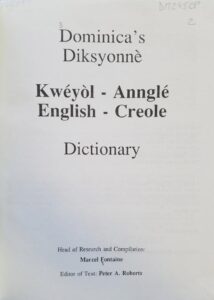 This content is provided by “Dominica’s Diksyonnè Kwéyòl -Annglé, English-Creole Dictionary” by Marcel Fontaine, 1991. Marcel Fontaine published a Kwéyòl Diksyonne in 1991.
This useful book has over 6,000 entries, a Pronunciation and Grammar Guide and Common Phrases; it can be found in local bookstores. Mr. Fontaine’s contribution in recording this traditionally oral language onto the written page is invaluable in helping to preserve it.
Listen to the DBS Radio Show “Esperyans Kwéyòl”
- Here is a segment from February 2025 on Facebook
- Here is a segment from February 2025 on You Tube
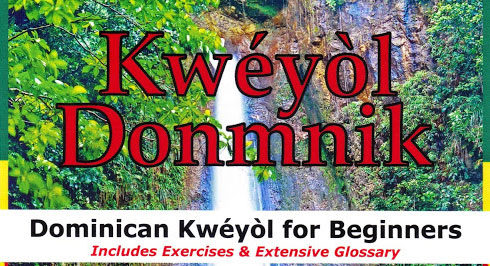
Learn Dominican Kwéyòl!
Written by by Sylvia Henderson Mitchell, this is an great book to learn the language basics and is easy to follow.
Colours
wouj – red
vè – green
woz – pink
blé – blue
kako – brown
owanj – orange
jòn – yellow
vyòlet – purple
blan – white
gwi – grey
nwè – black
Did you know?
In the northeast Villages of Marigot and Wesley creole is not widely spoken, but instead they speak a pidgin English called ‘Cocoy’ or ‘Kockoy’.
This is largely due to the mass migration of labourers in the 1870’s from islands like Antigua, who brought their own English creole with them. Learn more about it here.
Kwéyòl News
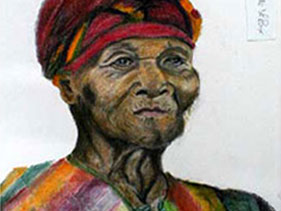
Creole Research Project Launched in Dominica – April 2018
Annou Apwann Kweyol
by Sonia Magloire-Apka
Purchase on Amazon
Recommended Reading ~ Learn to Speak Kwéyòl!
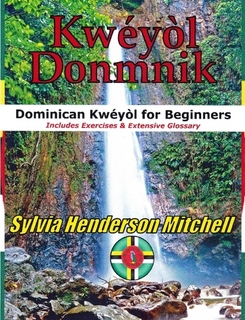
Kwéyòl Donmnik: Dominican Kwéyòl for Beginners
by Sylvia Henderson Mitchell
Buy on Amazon.com
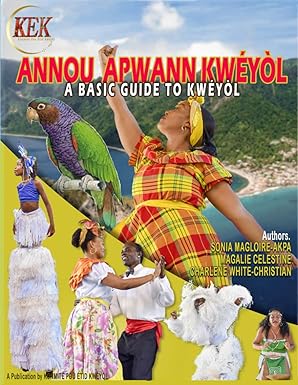
Annou Apwann Kweyol
by Sonia Magloire-Apka
Purchase on Amazon