This section features articles and illustrations by local historians. It also contains excerpts from ‘Our Island Culture’ by Dr. Lennox Honychurch.
The following is an outline of these folk dances which have grown out of the life of the people who danced them and so, like language, reveal something of their customs, habits and work.
QUADRILLE: A square dance of French origin. Four couple dance opposite and with each other. In the original Quadrille there are five separate and complete figures. The whole forms a set of Quadrille. This can take some time to complete, and since most are now done as public performances rather than for personal amusement, a number of sets are usually cut out. The pace of the quadrille has naturally been quickened and among the types danced today are the ‘Sharp’, ‘Slow’, ‘French’ and ‘Irish’ Quadrilles.
LANCERS: This is a later quadrille which came via Britain in the 1830’s and contained familiar figures from the traditional English dances and Scottish and Irish reels. It was popular with the military and the steps of the male
have a more stiff and formal pace.
MAZOOK: From the Mazurka which had its origins in Poland but was very popular in France and so came to the West Indies. The steps have great variety but the music pattern starts with a smooth glide on the third note, shuffle step for the
next note, another smooth glide and a series of cross steps until one is back to the first position. A special feature is the clicking and raising of the heels at the end of each round in the Heel and Toe Polka Mazook.
BÉLÉ: This probably is the earliest Creole dance which also has the strongest, virtually untouched African pattern. It has its roots in mating and fertility dance rites. There is a single instrument – the tambou drum – which is properly made of goat skin stretched over a hallowed tree trunk. The drum rhythm follows the steps of the single dancer who performs in a circle of spectators who also form the chorus or lavway for the lead or chantuelle. Although there are two dancers, only one usually dances at a time except at the end. The pattern usually is:
- Cavalier show physical style and prowess.
- Dam shows approval and tempts him.
- The Cavalier seeks the Dam once more.
- Both dance in the most heated piece.
In all paces dancing is directed towards the drum. Bélé is noted for the deep booming drum very vigorous body movement and steps, high pitched lavway with short and simple wording.
Its name is said to originate from the French ‘Belle Aire’, but because of it strong African pattern it must have had another earlier African name. Its present name may be based on the old French word ‘aire’ meaning ‘threshing platform’ which was like the coffee glacee.
The following are some other dances which were once popular but have either been lost or have been mixed with the Quadrilles and Mazook.
POLKA: This came from Eastern Europe and arrived here in the 1850’s. Its strong staccato quality was immediately popular and easy t adopt to the Creole rhythms.
COTILLION: Late 18th century dance. Named from the French for petticoat. Usually danced at the close of a set of Quadrilles.
SCHOTTISCHE: Pronounced in Creole ‘Sorti’, a 19th century dance similar to the polka.
CONTREDANSE: Two facing lines, one of men the other of women perform a variety of movements derived from other dance forms, often taking partners and dancing down between the two lines. A popular contredance was done to the music of the Ca Ira during the French Revolution.
LA RONDE: A dance done in a circle to Quadrille music.
FLIRTATIONS: was a simplar dance of this period.
QUADRILLE: A square dance of French origin. Four couple dance opposite and with each other. In the original Quadrille there are five separate and complete figures. The whole forms a set of Quadrille. This can take some time to complete, and since most are now done as public performances rather than for personal amusement, a number of sets are usually cut out. The pace of the quadrille has naturally been quickened and among the types danced today are the ‘Sharp’, ‘Slow’, ‘French’ and ‘Irish’ Quadrilles.
LANCERS: This is a later quadrille which came via Britain in the 1830’s and contained familiar figures from the traditional English dances and Scottish and Irish reels. It was popular with the military and the steps of the male
have a more stiff and formal pace.
MAZOOK: From the Mazurka which had its origins in Poland but was very popular in France and so came to the West Indies. The steps have great variety but the music pattern starts with a smooth glide on the third note, shuffle step for the
next note, another smooth glide and a series of cross steps until one is back to the first position. A special feature is the clicking and raising of the heels at the end of each round in the Heel and Toe Polka Mazook.
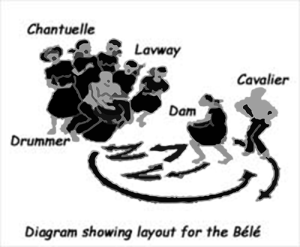
BÉLÉ: This probably is the earliest Creole dance which also has the strongest, virtually untouched African pattern. It has its roots in mating and fertility dance rites. There is a single instrument – the tambou drum – which is properly made of goat skin stretched over a hallowed tree trunk. The drum rhythm follows the steps of the single dancer who performs in a circle of spectators who also form the chorus or lavway for the lead or chantuelle. Although there are two dancers, only one usually dances at a time except at the end. The pattern usually is:
- Cavalier show physical style and prowess.
- Dam shows approval and tempts him.
- The Cavalier seeks the Dam once more.
- Both dance in the most heated piece.
In all paces dancing is directed towards the drum. Bélé is noted for the deep booming drum very vigorous body movement and steps, high pitched lavway with short and simple wording.
Its name is said to originate from the French ‘Belle Aire’, but because of it strong African pattern it must have had another earlier African name. Its present name may be based on the old French word ‘aire’ meaning ‘threshing platform’ which was like the coffee glacee.
The following are some other dances which were once popular but have either been lost or have been mixed with the Quadrilles and Mazook.
POLKA: This came from Eastern Europe and arrived here in the 1850’s. Its strong staccato quality was immediately popular and easy t adopt to the Creole rhythms.
COTILLION: Late 18th century dance. Named from the French for petticoat. Usually danced at the close of a set of Quadrilles.
SCHOTTISCHE: Pronounced in Creole ‘Sorti’, a 19th century dance similar to the polka.
CONTREDANSE: Two facing lines, one of men the other of women perform a variety of movements derived from other dance forms, often taking partners and dancing down between the two lines. A popular contredance was done to the music of the Ca Ira during the French Revolution.
LA RONDE: A dance done in a circle to Quadrille music.
FLIRTATIONS: was a simplar dance of this period.
More National Symbols