A look at the history of Dominica’s Carnival through the years
Written by Raymond Lawrence in 1998.
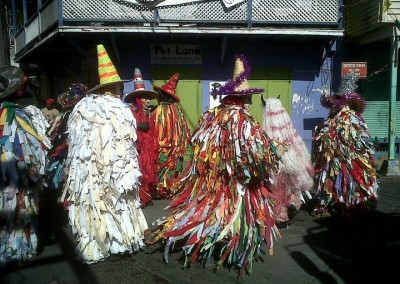
People who remember Carnival in the 1950’s and early 1960’s would remember all different types of costumes associated with Carnival such as ‘sensay’, ‘cowboys’ and ‘sooswell soowi’. There were also those which are hardly found in Carnival today such as Indians and Wob Dwiyet bands.
Of course other aspects of Carnival such as ‘la po kabwit’ and steel band features prominently. These were the two main types of music on the road.
One major Carnival event in those days was the Float Parade on Carnival Sunday afternoon at the Windsor Park. Business places and various organizations would build very creative and attractive floats with some special theme.
The trucks or trailers used for these floats were so well covered that you couldn’t even see the driver. Floats would also come into town from the rural areas with the participants on the floats singing some Carnival songs to ‘la po kabwit’ rhythms.
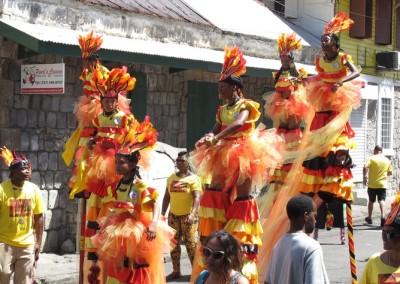
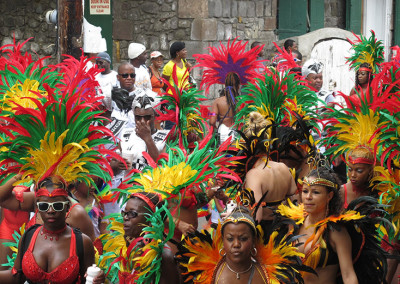
Carnival band presentation were always spectacular and band organizers went all out to ensure that costumes were well designed and representative of whatever theme they were depicting. The categories of judging then were usually historical, original, and advertising. The Thunderbirds of Newtown started organizing bands many years ago and has always staged impressive presentations.
The tragic Carnival fire in 1963, in which three people lost their lives and several persons were injured, changed the course of Carnival dramatically. The authorities of the day decided to ban sensays and all mask wearing, and I remember that the Carnival in the following year; 1964, had been reduced to a shadow of what it had been previously. As a matter of fact, there were persons who decided to stop playing Carnival from that year because of the fire incident.
In the years that followed, the Carnival shows began to play more of a prominent role in the festival. The Carnival Queen Show and Calypso competitions moved the Carib Cinema to a bigger stage at the Windsor Park.
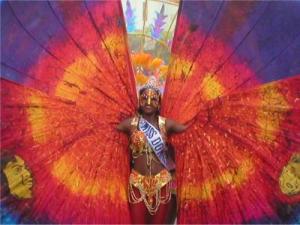
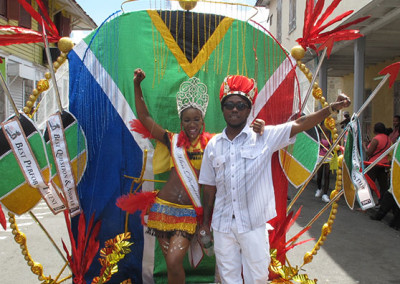
At the Carib Cinema in the 1960’s there were the crowning of Queens like Evadney Charles, Avonelle Shillingford, and Claudia Hill. Later on when the show was moved to the Windsor Park Queens emerged like Deidre Bellot, Rosemary Giraud, Eva Bruney, Anthea Mondesire, Kathleen Telemaque, Patricia Lander and Isabella Shillingford. Dominica won the Antigua Caribbean Queen Show title twice in the 1970’s with Kathleen Telemaque and Marie Louise Rock. We also won the CARIFTA Queen title twice with Anthea Mondesire and Esther Fadelle.
Calypso was of course a major part of Carnival as well. Some of the big names in calypso back then were the Idol, Spark Breaker (of Gaylords fame) and Solo.
There were also annual steel-band competitions. In the days preceding Carnival, the air would be filled with the sounds of steel-bands rehearsing for competitions and also for the road. Steel bands such as Whitchurch and Texaco were among the main steel bands of the day.
The Jaycees organized Carnival for several years in the 1960’s until 1972. Following the Jaycees, different Carnival Committees attempted to stage Carnival until the late 1970’s. Meanwhile, the costs of staging the shows had been mounting and a huge task of rebuilding a Carnival City every year in the Windsor Park had taken its toll on these various committees. In addition to these problems, Hurricane David struck in 1979.
At that time, the Cultural Division had just been set up with one member on its staff- Alwin Bully and in 1980, through the office of the Division he decided to form the Carnival Organizing Committee to administer Carnival. The Dominica Grammar School became the grounds for Carnival City and the Carnival shows continued.
Along with Carnival Queen shows, the OECS Queen Show was introduced in 1984. The was held every year until 1996. Dominica won the title a total of four times.
In the 1980’s the Carnival Queens included Anthea Burton, Diane Francis, Margaret-Rose Cools-Lartigue and Marcella La Rocque. Diane Francis went on to win the Caribbean Queen title in Antigua in 1986, while Marcella La Rocque won regional crowns in St. Maarten and St. Vincent.
In the 80’s hi-fi’s providing music on the road were then the popular trend and as a result steel bands were finding it difficult to compete with the amplified and non-stop music of the hi-fi’s. New efforts had to be made by the Carnival Organizing Committee and the Cultural Division to revive steel band and also to encourage ‘la po kabwit’ and other traditional aspects of Carnival.
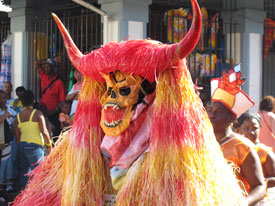
In our present day Carnival, we are once again seeing ‘sensays’, ‘sooswell soowi’, and ‘cowboys,’ and the ‘la po kabwit’ featuring in many events.
The Teenage Pageant, which brings together contestants from various schools in teen competition, has been organized by the Waitukubuli Dance Theatre Company; for several years. Before the name Teenage Pageant was introduced, this event was called the Junior Queen Show.
The 1990’s are proving to be an interesting era in terms of Carnival Development. We have seen the growth in popularity of live bands on the road for jump-up. We have also seen the re-introduction of ‘sensay’ to Carnival, mainly through the efforts of former Carnival Organizing Committee headed by Dermot Southwell, and there seems to be revived interest and appreciation for aspects of the ‘old time’ Carnival. So Carnival today reflects a rich mixture to the traditional and modern aspects of the festival.
The main Carnival band organizers have been Thunderbirds, Albert ‘Piwi’ Theodore and more recently Carnival has been making a name for itself.
Steel bands are slowly but surely making its way back on the music scene, thanks to bands like Fanta Pan and Phaze 5. New steel bands are emerging like the Goodwill School Steel Band and the Kairi Beacon Steel Band.
Meanwhile the 90’s have produced Queens like Martha Augustus, Gloria Ophar, Francillia Agar, Levi Beaupierre, Priscilla St.Ville, Giselle Francis, Kamala Jno. Baptiste.
Martha, Gloria, Francillia, Giselle and Kamala went on to capture some regional crowns for Dominica.
Calypsonians like Scrunter and Hurricane have been the main winners for the Calypso Monarch crown in the 90’s however other Calypsonians like the Brakes and Hunter have been able to capture the Monarch title at least once so far.
New recording studios in Dominica are now making it possible for calypsonians to record and promote their songs on CD and cassette. In addition the popular music bands like WCK and First Serenade are taking the opportunity to launch their new CD albums during the Carnival Season and their music is usually popular in the road.
A government appointed Dominica Festivals Commission has now been put in place to give Carnival firmer financial support. And so we can only hope that Carnival will continue to grow from strength to strength and that Dominicans will continue to give support to the Caribbean’s Most Original Carnival.
Read more about the history of carnival from Dr Lennox Honychurch: