The GliGli Project
The Kalinago Canoe Project (formerly the Carib Canoe Project)
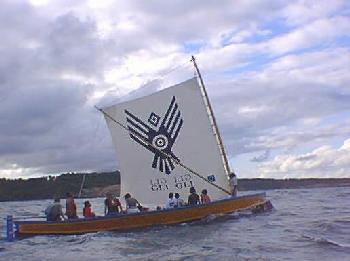
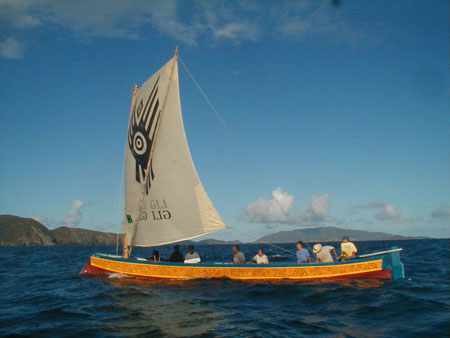
‘Gli Gli’ is a small, aggressive hawk revered by ancient Kalinago warriors as a totemic symbol of bravery.
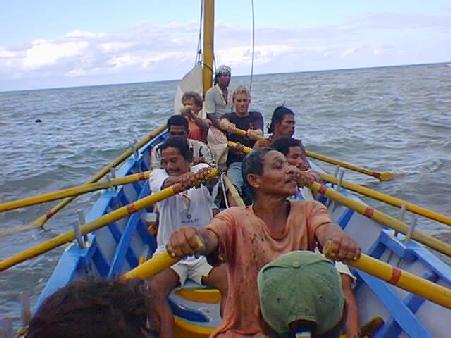
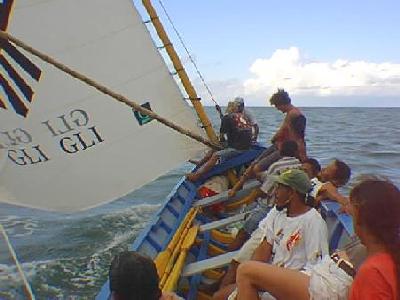
The ‘Gli Gli’ project constructed a canoe from ancient design using existing technology in Dominica and set sail in 1997 to complete a symbolic and practical journey to reunite the Kalinago with their ancestral and tribal homeland as the canoe and its crew members sail from Kalinago Territory in Dominica down the island chain, through the Orinoco Delta and into the river systems of North West Guyana, where contact was made with Guyanese Kalinago communities.
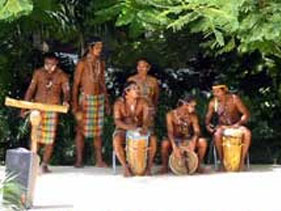
Throughout the journey, the project and its crew members aimed to raise awareness and promote discourse between Kalinago people and other indigenous groups in the Caribbean and South America. It also provided a unique opportunity to research aspects of Kalinago culture now forgotten, such as language, dance, games and traditional medicine.
Photos © Clay Mills
Edited and designed by Renee Hubka
Page © delphis 1997, 2002, 2015
About Dominica
Related Links
The Kalinago
Dominica’s History
Dominica Essentials
A History of Pirates in Dominica
Rum & Dominica
Dominica’s Heritage A – Z
Wooden Canoe Heritage Association
Carib Canoe Project – Aragorn Studio
The Kalinago encountered by Columbus in December 1493 were descendants of a wave of migrants from the Orinoco Delta, which had gradually moved into the Greater Antilles, assimilating the lands and women of earlier Amerindian cultures. Extensive movement between the islands was known to be undertaken in canoes cut from the same gommier trees (Dacryodes Hexandra) as are used today in Dominica.
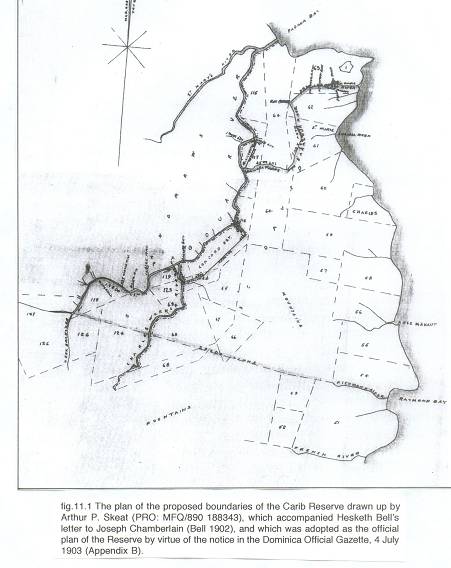
European colonial expansion in the region devastated much of the original Kalinago culture and has reduced the population to today’s few small communities on the islands of St. Vincent and Dominica. The latter is home to the largest surviving Kalinago society, numbering approximately 3000 people, who reside on lands reserved for them by Dominican law.
Traditional belief systems have long given way to Christianity, and the ancient languages replaced by French-English Creole, testimony to the waves of foreign influence to which Kalinago have been subjected.
Despite this advanced state of a-culturisation, farming and fishing are still the primary occupations in the Kalinago Territory, and traditional crafts such as basketry, calabash carving and canoe building also survive.
Throughout the journey, the project and its crewmembers aimed to raise awareness and promote discourse between Kalinago people and other indigenous groups in the Caribbean and South America. It also provided a unique opportunity to research aspects of Kalinago culture now forgotten, such as language, dance, games and traditional medicine.
Artists Jacob Frederick, of Dominica , and Aragorn Dick-Read, of the British Virgin Islands, first conceived of building a traditional Kalinago gommier canoe in August 1994, and then engaged the Kalinago Territory’s master canoe builder, Etien Charles (‘Chalo’), to oversee its construction, which began on the full moon in early December 1995.
Three week’s work in the rainforest followed:
- the tree was felled and carved in situ on site) using methods typical of contemporary Kalinago canoe-builders in which the chainsaw is as important as the hand adze (axe).
- Once carved, it took two days for forty people to haul the 35 foot canoe, the largest canoe to have been built in living memory, down to the village of Salybia in the Kalinago Territory.
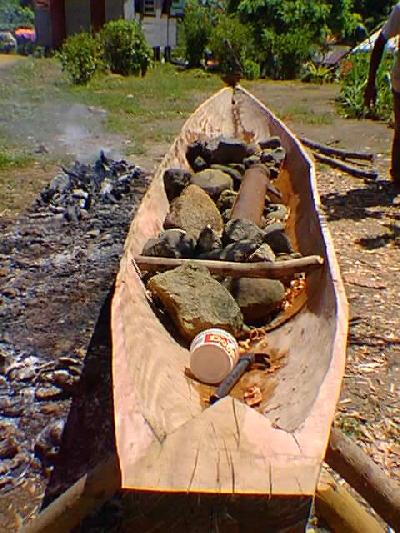
- The next phase of construction involved “opening” the canoe with rocks, water and fire. This happened in early March, after several weeks in which the canoe sat, weighed down with rocks and doused regularly with water. The heat of the sun and the weight of the rocks inside help the wood to warp outwards and downwards.
- The process climaxed in a dramatic morning at the end of the month in which fires were lit on either side of the canoe allowing it to open considerably.
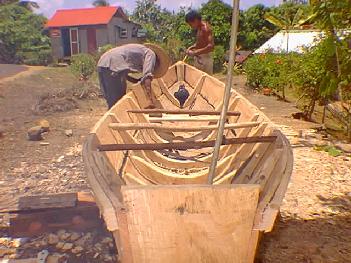
- The next day the “boardage,” was applied, raising the sides of the canoe and the first ribs screwed in.
- At the end of this stage ‘Gli Gli’ was transformed, with rails measuring approximately four foot in height and a beam of almost six foot.
Throughout the summer work continued. Canoe builders fitted the canoe with its mast, rudder, oars and seats. Measurements were taken from a traditional Kalinago sail and a scaled-up version was made for ‘Gli Gli’ by Quantum Sails in Annapolis, USA. Other sponsors included: Harris Paints, Dominica and The Paint Factory, Tortola – paint; T and W Machine Shop, Tortola – metal work; Richardsons Rigging, Tortola – rigging; Golden Hind Chandlery and Island Marine Supply, Tortola – tools and materials.
In late November ‘Gli Gli’ was transported to Marigot, just north of the Kalinago Territory, where final touches were made in preparation for her launch. A ceremony was held on November 30th, with speeches of support from then Kalinago Chief Hillary Frederick and Venezuelan Ambassador Pedro Camacho. Afterwards the canoe was blessed and anointed with coconut water and gommier smoke, before finally meeting the sea. It was a satisfying moment for all of those who had worked on her to see ‘Gli Gli’ catch the wind and sail gracefully out into the Atlantic. In the week of sea trials that followed, she performed extremely well in a variety of weather conditions and allowed the shortlist of crewmembers a taste of the journey ahead. The team was confident of the canoe’s seaworthiness and eager to begin the voyage.
The journey began in May 1997.
The “Carmella,” a 120 foot Dominican-built trading schooner belonging to Anthony Agar, acted as the support boat for the expedition. This classic West Indian trading schooner was not only ideal for accommodating the film crew and other team members, but provided a visually stunning partner for the ‘Gli Gli’ as the expedition sailed down the islands.
The journey itself was estimated to take two months – one month sailing down the islands, the other, motoring and rowing through the Guyanese rivers. All of the inter-island crossings were expected to take no more than one day, except for the Grenada to Trinidad leg, which would take around 36 hours. Stops at each island allowed rest periods for the crew, but also provided an opportunity to visit Kalinago communities and archaeological sites, for meeting the public, the media and schools, as well as for buying supplies and selling Kalinago craft work.
With the help of Dr. John Hemming of the Royal Geographic Society and Survival for Tribal People in London, the team was been able to widen contacts with Amerindian groups, anthropologists, and others in Northwest Guyana and Orinoco regions. On a research trip to Guyana, Dick-Read and Frederick were greatly assisted by Jennifer Wishart of the Walter Roth Museum. Through her direction they were able to make contact with various Kalinago and Arawak communities on the Pomeroon River, all of whom are keen to receive the ‘Gli Gli’ on its arrival.
The ‘Gli Gli’ project received a grant for 10,000 pounds from the C.T. Robinson Trust to partially fund the expedition and to aid research into the Kalinago culture.
The primary costs of the expedition were: the charter of Carmella as an essential support boat, supplying the crew and vessel for the journey, ensuring there is a medical emergency fund available should it be needed, and return flights for crew members from Guyana back to Dominica.
A ‘Gli Gli’ account was set up to receive donations, which was overseen by Peat Marwick, Chartered Accountants in the BVI. Donations in kind were also being sought for provisions and essential expedition equipment.
The project team included:
Co-Director Jacob Frederick, a Carib artist from Salybia, Carib Territory. Frederick has always been an artist and a thinker. A strong sense of his Carib identity is central to both his paintings and sculptures – which often depict aspects of Carib life today and ancient Carib mythology.
“We are the last of our race,” Frederick explained. “Our identity is disappearing so fast that we can’t afford to waste a single moment.” He has long been acting on this motivation – through his art, which has been exhibited in Dominica and Tortola; politics – he has twice been elected to the Territory’s ruling Carib Council; the Carib cultural group, Karifuna, and in the home, where he singlehandedly raises his six children.
Co-Director Aragorn Dick-Read, an artist from Tortola, British Virgin Islands. Dick-Read was born in the BVI, though he studied Tribal and Twentieth Century art for three years at the University of East Anglia, England. His work, mostly copper and steel sculpture, has been exhibited in London, New York and Tortola. His work is inspired by his close affinity to the natural environment and his extensive travels through Europe, the Americas, Southern Africa, Thailand, Nepal and Papua New Guinea.
Film Director Eugene Jarecki , an independent filmmaker of both dramatic and documentary subjects, trained at Princeton and New York Universities. Jarecki is also the Managing Director of Think Tank, a New York-based company specializing in creative work for film, television, and multimedia products. As a writer, director, and producer of dramatic films, music videos, documentaries, commercials, and stage productions, Jarecki has been recognized with honors from the Academy of Motion Picture Arts and Sciences, the Sundance Institute, the Aspen Film Festival, and the New York Independent Feature Project.
Artistic Director Garnett Joseph, current Chief of the Kalinago Territory but at the time of the Karifuna Cultural Group, and leading member of WAIKADA, the Kalinago Development Agency. Garnett has been working over the past eighteen years with the Karifuna Cultural Group – which is dedicated to reviving and maintaining the Carib culture. During the Gli Gli journey he will research and document Carib songs and dances that have survived on other islands and amongst Carib groups on the mainland. He will also be researching the Carib language in the hopes of finding Carib speaking individuals who would be capable of coming to Dominica to teach the language.
Historian and Documenture Alex Dick-Read, a freelance writer from the British Virgin Islands who specializes in Caribbean affairs. Having studied away from his native BVI for a number of years, first Social History at Bristol University, England, and then newspaper journalism at City University, London. Dick-Read has since moved back to the BVI where he is now a freelance writer, specialising in Caribbean affairs. His work appears in media worldwide, including the Guardian and Independent newspapers and the BBC in London, US and Caribbean media, and is regularly syndicated by Reuters International, as well as other agencies such as Inter Press Service and Associated Press.
Project assistant Federica Feliziani, TV producer for Datanord Multimedia, an independent production company working for Italian TV channels in Milan, Italy. In the past Feliziani has been a photographer and art director. She is assisting the ‘Gli Gli’ project with research, fundraising and making contacts with the Italian Television market.
Project Assistant Gordon Allum, an artist and sculptor from London, England. Allum is known mostly for his metal sculpture, which has been exhibited in London, Berlin and Paris. His projects encompass work for theatre, opera, film and television and he has collaborated with Dick-Read on a number of other artistic ventures.
Technical Advisor Clay Mills, a shipwright, sailor, and artist/musician. Mills built multi-hull sailing catamarans on the Island of St. Croix before moving to Tortola where he is now a charter boat captain. Hailing from Oregon with a rodeo upbringing, Mills has a creative writing degree, a boatbuilding degree, and is qualified to drive M-1 Main Battle Tanks.
Executive Producer David Fanning, a producer and writer. In 1980 Fanning produced and co-wrote “Death of a Princess,” perhaps the most well known of his documentaries. In 1982 he developed the award-winning PBS documentary series “Frontline” which is still running 13 seasons and over 300 films later. He has won numerous awards, including Emmys, for his work in the documentary field over the years. On hearing of the ‘Gli Gli’ project he was keen to become involved and has now taken on the role of Executive Producer.
Production Consultant Lowell Bergman, executive producer for CBS’s “60 Minutes,” and an investigative journalist. Bergman has offered to act as a production consultant for the project.
Support
The following organizations have offered their full support for the ‘Gli Gli’ Expedition which they believe will be of great benefit to the Carib People.
Kalinago Chief and Council, Kalinago Territory, Dominica
Waitukubuli Karifuna Development Agency (WAIKADA), Dominica
Dominican Tourist Board, Dominica
International Humanitarian Aid Concern (IHAC), London
Governor David MacKilligin, British Virgin Islands
Ambassador Pedro Camacho, Venezuelan Ambassador to Dominica.
Day 1, May 13
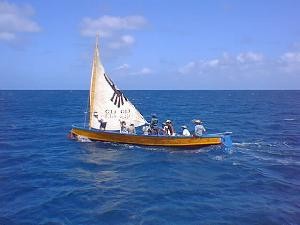
All crew of the Gli Gli and support ship Carmela had a successful crossing of the Dominica-Martinique Channel under strong wind (20-25 knots). It was a long day and strenuous start for the Gli Gli – which sailed reefed (partially rolled up) for most of the way – causing us to slip down below Martinique a few miles. We were fortunate enough to get a tow by a fisherman into St. Pierre before dark, where we awaited the Carmela.
 Day 2, May 14
We spent the day relaxing and sorting out the stores on Carmela.
Day 3, May 15
Our day began gently sailing down the leeward side of Martinique and stopping to help fishermen haul their nets to get us some fish. The winds picked up as we entered Fort de France Harbour and put Gli Gli through her first and hopefully last capsize experience.
No damage was done and nothing lost except Jacob Frederick’s glasses. As the Carmela was within sight and the seas were clam, it turned out to be an extremely useful exercise in rescue and recovery – both of which were accomplished within half an hour, allowing us to row safely into Fort de France habour. The rest of the day was spent selling craft work and provisioning the ships.
Day 4, May 16
Although sailing was smooth across the bay of Fort de France, coming around the point of Dimond Rock in the Gli Gli we found the head winds too much to cope with and gladly took a tow from the Carmela up to the bay of St. Ann.
After a peaceful sunset sail down to St. Luce, the generous Cargan family and members of the Association Gommier A Cours welcomed us. Some of the team slept in St. Luce.
Day 5, May 17
The morning was spent relaxing and sorting out stores on board the Carmela. Frederick paid a visit to some petroglyphs in St. Luce. At midday the whole team took a bus to Anse Arlet on the west coast to watch the finish of the first Gommier race of the banana cup. It was a great sight to see gommiers sailing in under enormous sails – with all the 10 crew linking out poles to stabilise the narrow canoes. The Carib canoe gliders were much inspired by the racing canoes.
We sold crafts and played drums on the beach until dusk. The next morning we successfully sold crafts around the boats.
Day 6, May 18
The day was spent on board the Carmela – some of us went fishing on the over-fished reef. The winds were high and the forecast bad – threatening the possibility of crossing to St. Lucia.
Day 7, May 19
Good winds – from the north east – confirmed the decision to cross the channel to St. Lucia. Gli Gli left at around 8 am and made good speed even under the lateen sail (triangular sail). Swells from the east made the trip a bit rolley as a squall mid-channel sped up the crossing greatly and caused no trouble. We reached St. Lucia at about 12:30 pm to a warm welcome from the St. Lucia National Trust at Pigeon Island.
Patricia Charles and Victor Eudoxie had arranged an amazing reception with T.V. cameras, live radio broadcasts, lunch and showers.
Day 8, May 20
After another successful morning hussling around the two boats at Pidgen Point, we sailed beezily against the current to Castries in St. Lucia. As the wind totally died at the harbour mouth, we gladly took a tow from a fellow Gommier into the harbour.
Some of the crew spent the afternoon selling craft alongside the canoe and others went to the Folk Research Center, where we showed the video of the Gli Gli’s construction and slides to a selection of students from five schools. The response was excellent and the students asked intelligent questions.
We did our best explaining of the regional importance of Carib culture and started the job of breaking down standard myths about Caribs that have been propagated over the past 500 years. It was an extremely satisfying experience and, although spontaeously put together, served as a good trial for what we would like to accomplish – to educate peoples of the region about Caribs and Carib culture.
In the evening we received sad news that Son, the basket maker of the expedition, had to return to Dominica because his child was seriously ill.
Day 9, May 21
The morning was spent in Castries organizing Son’s departure and using The National Trust’s ideal office facilities. Local businesses gave us a generous supply of chicken, juices and fresh vegetables. In the afternoon we sped over the flat water down the leward coast enjoying the beautiful scenery and, as usual, watched for gusts.
Tim, a friend from Tortola, passed on advice he read from an 18th century sailing guide for the windwards, which suggested either sailing a mile off shore or within a “pistol shot” of shore. We can confirm the value of the pistol shot theory. It seems the coastal current is not so strong, except on the points, and the breeze, although sometimes gusty, is more forthcoming close to shore.
The sail into Souffriere Bay was one our most spectacular and amusing so far. The beautiful town – set deep in the bay north of the Pitons – had the whole population of school pupils out to greet us. The beach was black with children all screaming and wailing.
As we neared the jetty the children’s exitment grew, but as the Gli Gli turned to use the wind to guide it in (thus facing the other way) there was an instant lull when the childern wrongly thought we were headed for the other dock along the beach. In an instant there was mass rush to the other dock. When we turned back to glide into the original spot they had been waiting, they swarmed back to meet us!
Carmela came into the bay as the sun wassetting and we settled into a peaceful night after the buzzing crowd disapated.
Day 10, May 22
All day we were in the hands of the National Trust representative at Suffriere who organized school visits and more school visits – all of which we managed to pull off with conviction.
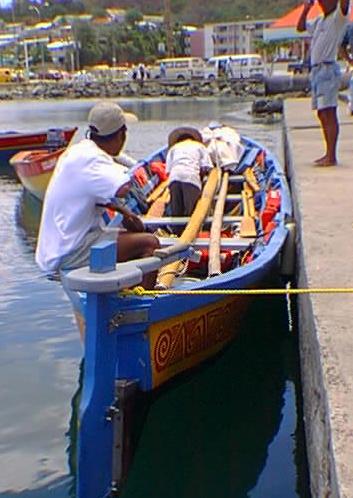
We also had an interesting visit to Pralin, a town on the south east coast, where Carib-style Gommier canoes are still made. Chalo, Morlin and Prince took a keen interest in their techniques but found them to be a little different from their own. The canoe makers of St. Lucia make a longer pince to their canoe .
Although gommier trees are left in St. Lucia, an increasing amount of fiberglass boats are being used. Building Gommier canoes seems to be a dying art even though it is still a source of pride for the few communities involved.
After stopping in Vieux Fort, we had an inspiring visit to the Carib pottery makers on the south west tip of the Island. They demonstrated their ancient techniques amongst beautiful wattle daub (wickerwork plastered with mud or clay) huts. To make their pots, they dig, clean and pound the clay on the spot at their pottery studio and at once handbuilt them (no pottery wheel). The pots are then dried and burnished – ready to be fired in an open fire.
The Pitons in St. Lucia The older mixed-blood Caribs in this community were happy to meet their fellow tribesmen and had much to talk about. We found out that they had once been great canoe builders (though there is not a tree in sight these days). They passed on useful advice about sailing across the channel to St. Vincent and warned us of the strong currents coming down from Vieux Fort. It was hard to leave them.
That evening we bathed by moonlight in the incredible hot springs under the Pitons. – completing the magic of our stay in St. Lucia.
Day 11, May 23
An early start in the Gli Gli took us down past the awe inspiring Pitons as we set out under full sail. Watching for the heavy down blasts that come off the mountains, we sailed into a strong current as we began the crossing. After a couple af hours we cleared the current and could ease off a bit and head for St. Vincent’s volcano. It was a long but peaceful crossing in ideal conditions, even though we didn’t catch any fish.
We reached the leward coast of St. Vincent as the sun was going down and instead of going into Chateaubelair, we decided to take a tow from Carmela to Kingstown.
Day 12, May 24
On waking up in Kingstown we began by organizing the expedition up to the Carib community in Sandy Bay. Pat Frajer, leader of the Carib cultural group, gave all of the Carib crew and three of us non-Caribs a warm welcome.
The rest of the afternoon some crew hung out in the village chatting and making friends with the “Black” Caribs and others went fishing in the heavy Atlantic swells. The Black Caribs are known as such because when a slave ship wrecked on the shores of St. Vincent before Europeans colonized the island, the survivors became part of the Carib community. Their spirit of apartness and “Caribness” is still strong.
The evening was spent with the Carib cultural group drumming (we bought some of our own) all around the village. The atmosphere was fantastic and the brotherly/sisterly feeling between the two groups of Caribs was strong and binding…like the rum!
Day 13, May 25
The St. Vincent Caribs took us on an amazing drive in the back of a pick up along the cliffside road to the village of Fancy. We passed the “Bloody Bridge” where the famous Carib leader Chatonyer was killed by the British during the Carib Wars in the late 1700s. His legacy lives on and the glimmer of his spirit of resistance can be felt.
This is a rugged area and clearly a last desperate stronghold of a people forced from their tribal lands. The hillsides are cleared (sadly,no more Gommiers here) and planted in near vertical terraces of peanuts, arrowroot, cassava and tomatoes. The visit to Fancy was quiet but interesting. We saw stone tools that villagers had discovered in their fields.
In the afternoon we cooled off by the Salt Pond – a saltwater pool set in the rocks on the rugged coast. The Caribs of the group spent the night at Sandy Bay while we non-Caribs returned to Young Island where the Carmela and GliGli was awaiting us. The connection has been forged and friendships made that will hopefully strengthen the unity of the Carib tribe in the future.
Day 14, May 26
We gathered provisions in Kingstown and awaited the return of our Carib crewmembers. New crew arrived from Tortola, by boat and plane.
Day 15, May 27
We got an early start as a good breeze sent Gli Gli flying across the channel to Bequia. On entering Admirally Bay, we met the biggest flottilla yet with much horn blowing and cameras snapping. After a speedy and gusty sail up the bay we rowed in under escort to the Frangipani Hotel where an amazing reception was organized for us by Otmar Schaedle, Tom and Sally Erdle and other generous residents of Bequia.
We drank, partied and sold crafts the rest of the day. In the evening we were entertained in splendor surronded by the rubbings of the St. Vincent Petrogliphs at Schaedle’s hotel “The Old Fort” – an amazing night which topped off a wonderful day.