Besides rivers, Dominica has no shortage of mountains. Green cushioned edifices competing for space in this small island. Where Dominica lacks in horizontal space, she gains in vertical. There are at least 26 mountains, 9 of which are dormant volcanoes, and the highest being almost 5000 feet. Dominica has the highest concentration of dormant volcanoes in the world, adding to her already unique status.
Read on for more information about Dominica’s
Quick Facts
With so much of the interior and part of the coast forested and or protected there is much to see
# of Dormant Volcanoes: 9
# of Sites:
Highest Elevation: 3,000
Lowest Elevation: Sea level
Dominica's Geology
by David Lang
Dominica has nine main volcanic centres, the highest concentration of “live” volcanoes in the world. This page takes a closer look at our fascinating geology.
Dominica is built on a broad submarine ridge of (probably) Early Tertiary age (that is about 60 million years ago) or perhaps even older deposits. It is one of the Volcanic Caribees, the more western line of a double island-arc, the other line of which is mainly built of limestone. Dominica is almost entirely composed of volcanic rocks.
Geological History
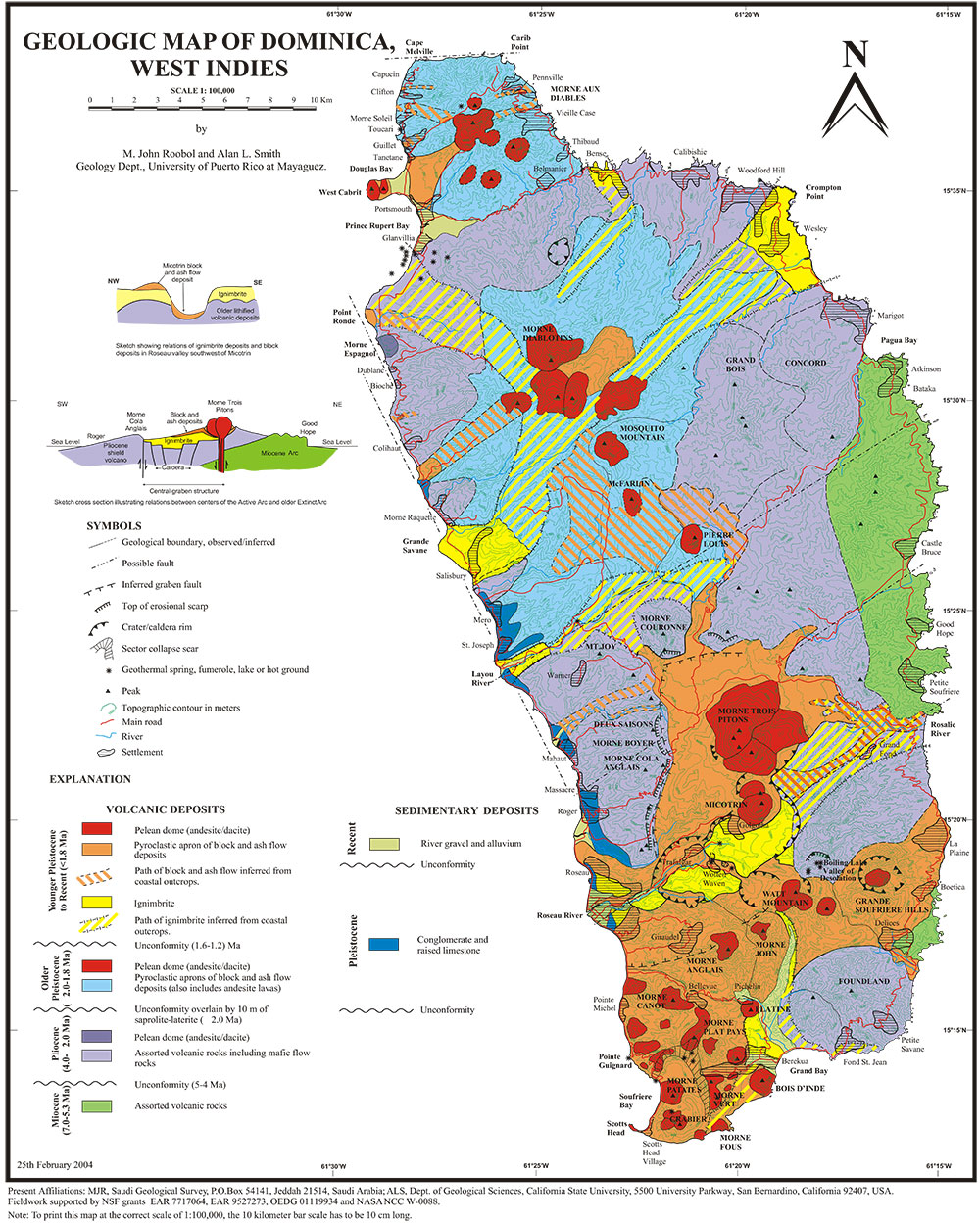
The earliest rocks visible on Dominica are found along the east coast (Pagua-Rosalie and some remnants further north and south.) These are lavas and breccias of late Miocene and dykes of Pliocene age (up to 7 million years old). The lavas may appear as red, deeply weathered materials and they are often partly covered by much younger ash deposits.
In early Pliocene time (perhaps 2-3 million years ago), coarse sedimentary rocks comprised of volcanic materials and some limestones were laid down (and are exposed in west coast cliffs). They form the basal part of Morne Diablotins. Foundland and the Cochrane area, which form the basal part of Morne Trois Pitons are older, possibly late Miocene.
In middle Pliocene time (about 2 million years ago) basaltic-andesitic shield volcanoes were built in the south of the island and west of the earlier lavas. Some of the deposits are pillow lavas deposited under the sea, and examples can be seen near here, (Springfield), by the public road at Antrim.
But the most important mountain building period was in the Pleistocene, when a line of dacitic-andesitic composite volcanoes was superimposed over the less lofty earlier shield volcanoes: Morne au Diable (Pelean), Morne Diablotins, Morne Watt, Morne Anglais, Morne Plat-Pays, are all about 400,000-500,000 years old.
Still later, only 30,000 years ago, a very large eruption, the Roseau ignimbrite eruption took place from near where Trois Pitons stands. Ash and pumice flows filled several valleys and the deposits extended several hundred km from Dominica. The whole deposit is equal in volume to about 60 cubic kilometres of solid rock.
After this, large dome complexes, of which Morne Trois Pitons is the most spectacular example, were formed , usually in the crater of a large volcano, the latest being that of Morne Patates,the most recent dated deposits of which are about 450 years old (Holocene).
The Historic Past and Present
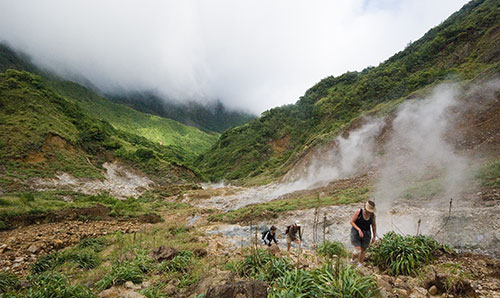
Activity during the historic period has been mainly of the form of phreatic and phreato-magmatic explosions, (phreato meaning that water draining from the surface was involved), the last having been located in the Valley of Desolation in 1880, often leaving maare (lakes like that at Woodford Hill) or craters (Du Mas Estate, top end of Morne Prosper e.g).
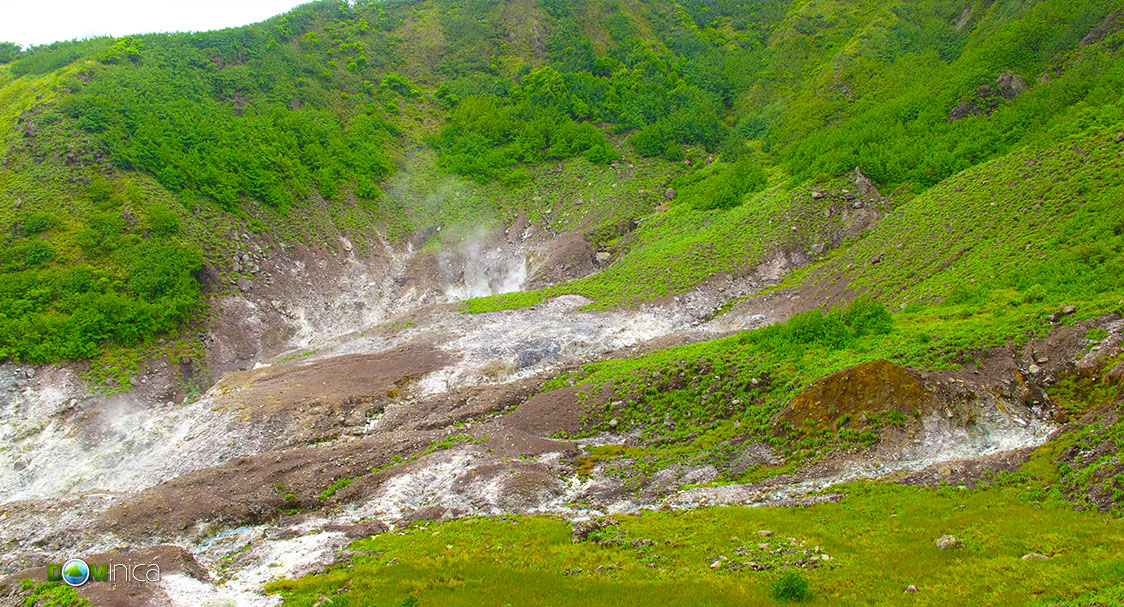
Valley of Desolation, seen along the hike to The Boiling Lake

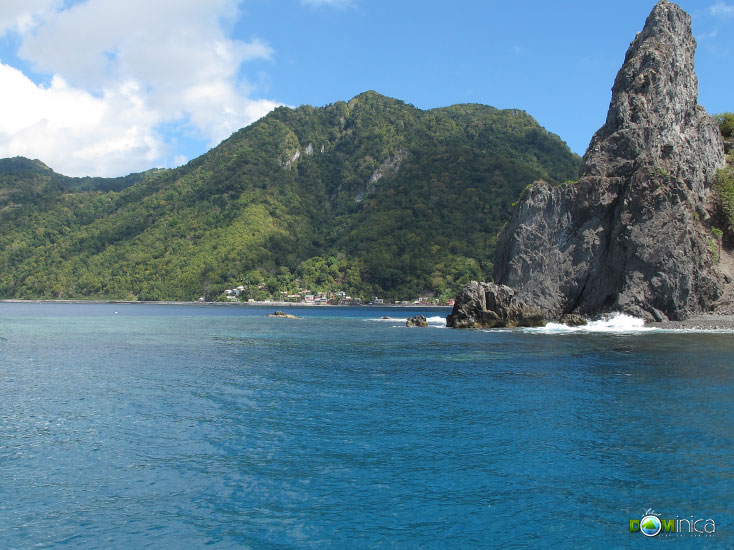
Rodney’s Rock, found along the west coast
The Rocks
Main rock types:
Basaltic lava Flows – The most abundant type of lava, known as mafic lava which when cooled forms basalt. Antrim valley for example
Andesitic tuffs – (some welded) and ashes, (some dacitic) and agglomerates (widespread, but dacitic materials which include little quartz crystals of diamond shape are confined to the North East, e.g Calibishie)
Dacitic Andesitic lavas – (Micotrin, Trois Pitons) [also microdiorite, (Imray’s)]
Reef Limestones and Conglomerates – West coast – notice it as you drive along the highway the cliff faces and outcrops of rock
Tectonics
“Plate tectonics” — for those interested in modern interpretations of the geology:
The Caribbean ‘plate’ is overriding the Atlantic ‘plate’, which is being ‘subducted’ down and providing materials which become part of the magma which fuels the Lesser Antillean volcanoes.
The locus of the edge of the Caribbean ‘plate’ is perhaps 50 miles east of Dominica, and the crumbling edges of both plates are responsible for the seismic activity so common off east Dominica and in Southern Dominica.
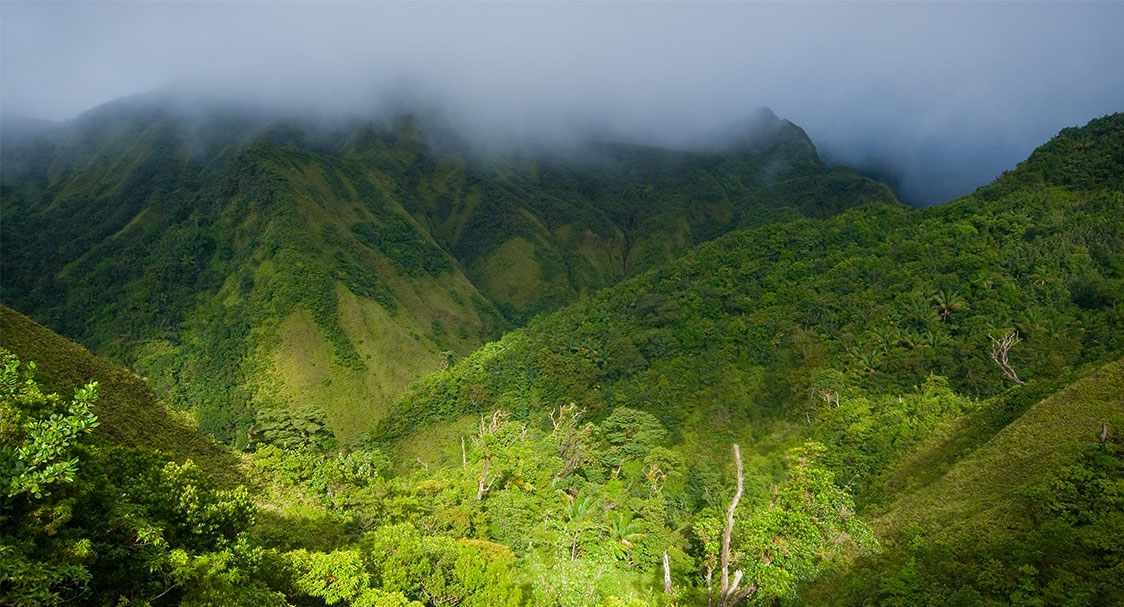
Valley of Desolation, seen along the hike to The Boiling Lake
Where can you see it?
Soufrieres
Sulphur deposits found around the island
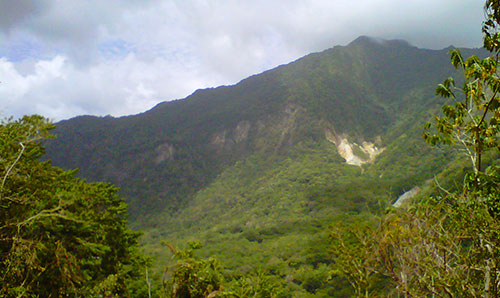
Valley of Desolation, seen along the hike to The Boiling Lake


Hot Springs
Areas where hot water surfaces
- Wotten Waven
- Trafalgar Falls
- Check Hall
- Champagne Beach
- Layou
- Titou Gorge
- Morne Trois Pitons National Park
- Picard
Geysers
Geysers are hot springs which intermittently boil occasionally spewing water and steam into the air
Valley of Desolation, seen along the hike to The Boiling Lake
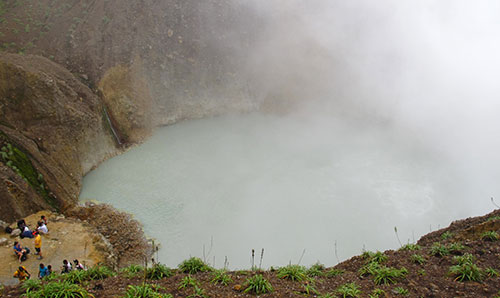
Valley of Desolation, seen along the hike to The Boiling Lake
Lakes
The infamous Boiling lake and Valley of Desolation